Traffic categorization
Traffic categorization is how Kleerr turns session evidence into reporting labels such as channel, source, campaign, platform, and acquisition type.
This page is the technical reference for operators who need to understand why a session landed in a specific traffic bucket. For a shorter overview of return visits, see Session continuation. For identity and coverage docs, see Identity and session coverage. For the ad and campaign parameters Kleerr reads, see Kleerr parameters.
How dimensions are reviewed
The same classified session can be reviewed through different lenses depending on the question you are asking:
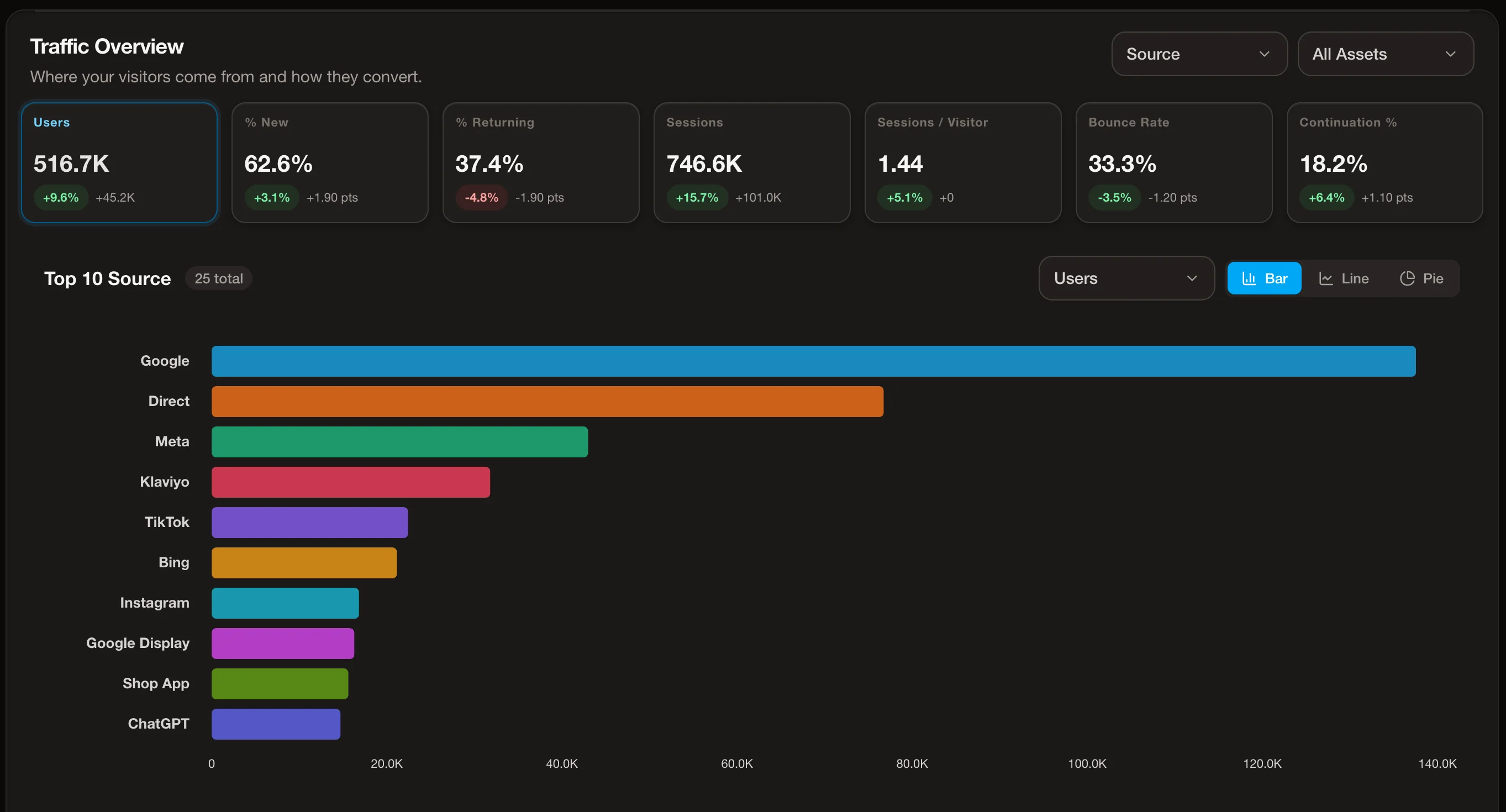
- Channel answers the broad source question: Search, Social, Email, Referral, Direct, AI, and similar traffic buckets.
- Source answers where the session came from at a more specific level, such as Google, Meta, Klaviyo, linkedin.com, ChatGPT, or a referring site.
- Acquisition type answers the commercial relationship: paid, organic, owned, partner, direct, or continuation. Use this when you want to separate paid acquisition from owned lifecycle traffic, organic discovery, partner traffic, and direct/return behavior.
- Campaign answers which named campaign was present on the session. Kleerr uses campaign evidence from UTMs, Kleerr ad parameters, tracking links, and connected platform metadata where available. If no campaign evidence exists, the session can still be classified by channel and source.
- Platform answers which supported source platform the session maps to, such as Google, Meta, TikTok, LinkedIn, or Amazon. Platform is not automatically the same as paid ad traffic; a platform can generate paid, organic, referral, or owned activity depending on the evidence.
Use these dimensions together. For example, Google can appear as Organic Search, Paid Search, Shopping, YouTube, Referral, or Google Business Profile depending on the signals available. Meta can appear as paid social when ad evidence is present, or as organic social/referral when it is not.
The Website overview also shows Continuation % beside the traffic metrics. This is the share of sessions where Kleerr preserved prior source context for a returning visit. It helps separate new acquisition from return behavior while keeping the original source visible for analysis. See Session continuation for how return visits keep source context.
These dimensions let Website, Marketing Performance, Advertising, and attribution reports use the same underlying session classification.
Inputs Kleerr evaluates
Kleerr evaluates first-party and URL-level evidence when a session starts or is updated:
- landing URL and query parameters, including UTMs;
- Example: utm_source=klaviyo&utm_medium=email&utm_campaign=spring_sale resolves to an Email session from Klaviyo with campaign spring_sale.
- Kleerr tracking parameters;
- Example: klr_p=google&klr_c=123&klr_ag=456&klr_a=789 resolves to a paid Google Ads session that can be joined to campaign, ad group, and ad data.
- supported ad click IDs such as gclid, fbclid, and ttclid;
- Example: a gclid can identify Google click activity. Kleerr treats it as paid only when the rest of the evidence supports paid acquisition.
- referrer domain;
- Example: a referrer from linkedin.com can resolve source as LinkedIn when stronger URL parameters are missing.
- known platform source patterns;
- Example: Facebook or Instagram click/referrer patterns can identify Meta as the source, but they do not automatically make the session paid.
- first-party session continuity from the browser;
- Example: a visitor first arrives from Google Ads, then returns directly in the same browser. The return visit can be marked as Continuation with the Google Ads context preserved.
- identity-confirmed continuity when browser continuity is not available;
- Example: a visitor identifies with an email or order after returning on a different browser. Kleerr can connect the return to earlier activity when identity evidence is strong enough.
- store and account domains, so checkout and subdomain movement do not become
artificial referral traffic.
- Example: a checkout or subdomain hop is ignored as a new referral. Kleerr continues the prior source when one is available.
Kleerr does not treat every ambiguous signal as paid. A click ID or referrer can identify a source, but paid acquisition requires paid evidence.
Priority order
Traffic categorization is evidence-based. Stronger evidence wins before weaker evidence is considered:
- Kleerr ad tracking parameters identify supported paid ad traffic.
- UTMs identify source, medium, campaign, and acquisition type.
- Supported click IDs identify source or refine channel; paid acquisition is used only when the evidence is clearly paid.
- Referrer is used when stronger URL signals are missing.
- If the current visit has no clear source, continuation can preserve a previous non-direct source for the same visitor or browser.
- If Kleerr can tell the visit is a continuation but cannot resolve a source, it can surface as Continuation (no source).
- Direct is used when there is no reliable source and no continuation context.
A previous non-direct source means an earlier session that had meaningful marketing context, such as paid search, email, organic social, referral, or another source that is not Direct. If a visitor returns with no new source evidence, Kleerr can carry that earlier context forward and mark the visit as a continuation.
Continuation (no source) appears when Kleerr has continuation evidence, such as browser or identity continuity, but there is no reliable non-direct source to carry forward. Direct appears when the visit has no reliable source and no continuation context.
Platform traffic
Platform-owned domains do not automatically mean paid ads.
- A Google referrer without paid evidence is not automatically Google Ads.
- Facebook or Instagram evidence can identify Meta as a source, but paid acquisition still requires paid UTMs, supported paid identifiers, or Kleerr ad tracking parameters.
- Connected platform campaign details can refine the channel after the first pass. For example, Google Ads campaign type can separate Search, Shopping, Video, Display, and Cross Network.
This matters for attribution reporting. A Store Attribution table grouped by Ad Platform can include all eligible traffic mapped to that source platform, including organic or referral sessions, depending on the selected attribution model. The Advertising page is narrower: it focuses on paid acquisition rows that map to supported ad platforms, spend, and paid-ad performance. So "platform attribution" in Store Attribution means source-platform credit; "Advertising" means paid-media reporting.
Direct and self-referrals
Direct is used when Kleerr does not have reliable source evidence and cannot continue a previous non-direct source.
Store self-referrals and same-property hops are stripped so checkout movement, subdomain movement, and internal redirects do not create false referral traffic.
How categorization affects reports
- Website can show all classified sessions.
- Marketing Performance uses the same source and channel labels when it compares revenue and traffic.
- Advertising focuses on paid acquisition rows that map to supported ad platforms.
- Attribution reports link orders back to eligible sessions and apply the selected attribution model.
- Builder and detail views can expose session and event context for investigation.
For how return visits preserve source context, see Session continuation. For order-credit logic, see Attribution overview.