Attribution overview
Kleerr attribution starts with store orders, then works backward through first-party sessions to decide which visits should receive credit. The goal is to keep revenue grounded in the commerce platform while preserving the marketing context that brought the customer to the store.
The short version
Kleerr answers three questions for each order:
- Who was this? Link the order to known visitor, session, and customer context using first-party identifiers and commerce-platform identity.
- What visits were eligible? Find the customer's sessions inside the attribution window and keep the acquisition context for each visit.
- How should credit be split? Apply the selected attribution model and roll the credited order revenue into channels, sources, campaigns, and acquisition types.
Kleerr does not use ad-platform revenue as the source of truth for Kleerr-attributed revenue. Platform-reported values are shown separately where they are useful for reconciliation. For revenue-source differences, see Revenue sources and reconciliation. For the journey context used to connect orders and later server-side events back to earlier sessions, see Kleerr Identity Graph.
Order source of truth
The completed commerce order is the conversion source of truth. Browser events and ad-platform pixels can help explain the journey, but the order total comes from the store platform.
Order-time customer identity, when available, helps connect the order back to prior first-party sessions for the same buyer. When an order has no first-party session link, session-basis attribution does not invent a session path for it. Kleerr never fabricates a browsing journey to fill the gap.
There is one Advertising-page exception: if a store order has no usable browser session link but the commerce platform already identifies it as coming from a paid ad source, Kleerr can include that order as paid-source fallback revenue. This fallback is kept separate from session-evidenced revenue for auditability and is not counted twice.
Eligible session path
Before attribution credit is assigned, Kleerr builds the order's eligible session path:
- Sessions are tied to the buyer through first-party session and customer context.
- Each session already has resolved traffic classification from the continuation and categorization layer.
- Sessions are evaluated inside standard lookback windows.
- The attribution method determines how much credit each eligible session receives.
The session path can include paid, organic, referral, email, direct, and other classified visits. Which sessions receive credit depends on the selected model.
Attribution basis by report
Attribution always starts from known outcomes and eligible tracked sessions, but the basis can differ by report:
- Store revenue is the full commerce-order reference.
- Store Attribution focuses on session-evidenced credited revenue.
- Advertising revenue can combine session-linked paid attribution with paid-source fallback where documented.
- Platform revenue is the ad platform's claim, not Kleerr attribution.
This is why attribution revenue can be lower than Store revenue and different from platform revenue. The underlying order does not change; the reporting lens changes which part of the order path is being inspected.
When attribution is grouped by Ad Platform, the platform label means the source platform Kleerr mapped the session to, not necessarily a paid ad click. For example, Google-sourced sessions can include paid search, organic search, YouTube, Google Business Profile, or referral-style traffic depending on the evidence. This is broader than the Advertising page, which focuses on paid acquisition rows tied to ad-platform spend and paid media performance.
An anonymized purchase journey
The timeline below is based on an actual purchase journey, anonymized for documentation. It shows why Kleerr keeps the full first-party journey instead of giving all credit to the final visit.
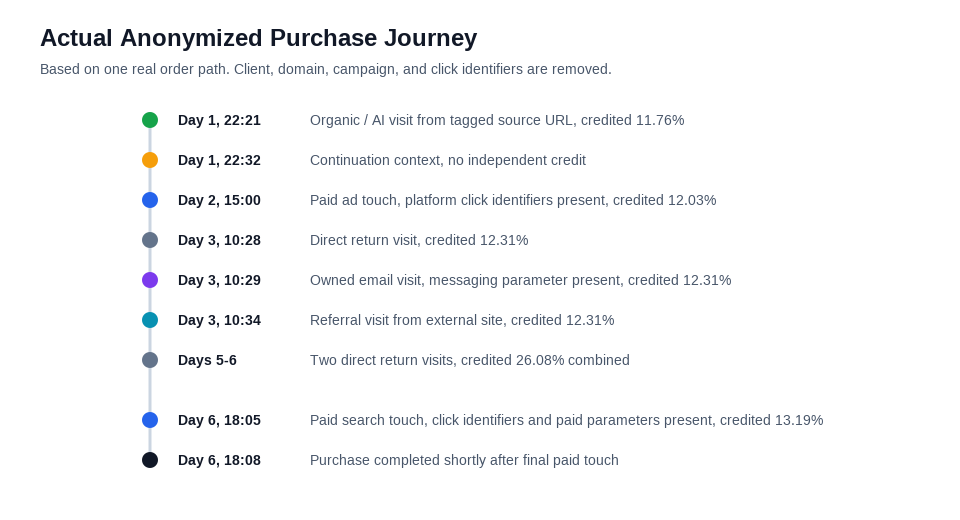
Why this matters: the purchase was not a single-click journey. Kleerr split credit across observed touches, while continuation context preserved source context without receiving independent credit.
| Step | Gap / time before purchase | Touchpoint | Evidence available | Final credit |
|---|---|---|---|---|
| 1 | Start; 4d 19h 47m before purchase | Organic / AI visit | Tagged source URL | 11.76% |
| 2 | 11m later; 4d 19h 36m before purchase | Continuation context | Same journey continuation | 0.00% |
| 3 | 16h 28m later; 4d 3h 8m before purchase | Paid ad click | Platform click identifiers and paid parameters | 12.03% |
| 4 | 19h 28m later; 3d 7h 40m before purchase | Direct return | First-party return visit | 12.31% |
| 5 | 1m later; 3d 7h 39m before purchase | Owned email | Messaging parameter | 12.31% |
| 6 | 5m later; 3d 7h 34m before purchase | Referral | External referrer | 12.31% |
| 7 | Two returns: 24h 22m and 7h 44m before purchase | Later direct returns | First-party return visits | 26.08% combined |
| 8 | 7h 41m after prior return; 3m before purchase | Paid search click | Click identifiers and paid parameters | 13.19% |
| 9 | 3m after final paid click | Purchase | Commerce order | Order value split above |
This kind of journey is common: a buyer can move through paid ads, direct returns, owned messaging, referrals, and continuation context before ordering. Kleerr keeps those touches tied to the actual order, then applies the selected attribution model to split revenue without duplicating the order total.
Attribution models
Attribution models decide how credit is assigned among eligible sessions. Kleerr produces order-level attribution rows for supported models and lookback windows. The dashboard uses the account's selected attribution method when it asks for attributed revenue. If an account has not selected one, the fallback model is Time Decay (30-day).
Supported model families include:
- First touch: credits the first eligible session.
- Last touch: credits the most recent eligible session.
- Last paid: credits the most recent paid session when one exists; if the path has no paid session, it gives partial credit to the last touch.
- Linear: splits credit evenly across eligible sessions.
- Time decay: gives more credit to sessions closer to the order.
- U-shaped: emphasizes the first and last eligible sessions.
Attribution rows are produced across standard windows of 3, 7, 14, 30, 90, 180, and 365 days. Customer-facing reporting uses the relevant model and window for the page.
The Advertising page reads the 30-day-lookback attribution rows for ad-revenue metrics, but it still honors the selected or default attribution model. The 30-day lookback is fixed for this page; the model is not. The configurable per-account lookback applies to store-level reporting, not to the Advertising page.
The model changes credit distribution. It does not change the underlying order, CRM event, or total order value.
How continuation affects attribution
Continuation is resolved before order attribution. That means a later Direct return can still carry the earlier non-direct source when the session chain supports inheritance.
Continuation preserves source context, but it does not create extra independent source touches. If a buyer clicks a paid ad, returns directly twice, and then orders, Kleerr can still understand those returns as continuation of the paid source. It should not count the same paid source three separate times simply because the buyer came back several times.
For single-touch models, the eligible touch can resolve back to the continued source. For multi-touch models, repeated continuation visits are collapsed so credit is based on distinct source touches, not duplicated continuation sessions. This keeps repeated direct returns from inflating paid or organic credit.
Example: if the journey is Meta → Meta continuation → Google, continuation maps the return visit back to the Meta source session. Under Linear attribution, credit is split 50/50 between Meta and Google. The Meta continuation does not become a second Meta touch and does not dilute Google credit.
For the return-visit and traffic-classification layers behind this behavior, see Session continuation and Traffic categorization.
What Kleerr does not do
- Kleerr does not invent orders that are missing from the commerce platform.
- Kleerr does not use ad-platform revenue as Kleerr-attributed revenue.
- Kleerr does not let every ad platform independently claim the same order inside Kleerr-attributed revenue.
- Kleerr does not use black-box modeled conversions to fill attribution gaps.
- Kleerr does not count organic Google Search as Google Ads without paid evidence.
Influenced vs attributed
Influenced means a session or touchpoint appeared somewhere in a journey that produced an outcome. Attributed means a model assigned credit to that session or touchpoint.
Example: a blog page can influence an order by appearing in the buyer's journey, but a last-touch model may attribute the order to a later email or paid click.
Where this appears in the dashboard
- Store is the top-line ecommerce revenue source.
- Store Attribution is where you inspect model credit by channel, source, campaign, platform, or channel type.
- Marketing Performance rolls attributed performance into KPIs, channel analysis, recommendations, and traffic context.
- Website shows session volume, classification, continuation, and traffic behavior before those sessions become order credit.
- Advertising shows store-order revenue attributed to paid ad platforms beside each platform's own reported revenue.
- CRM shows pipeline and deal outcomes when a CRM is connected.
For advertising-specific metric definitions, see Advertising page metrics and attribution.