Kleerr parameters
Kleerr parameters are URL parameters added to ad and campaign links so Kleerr can tie a website session back to the exact platform, campaign, ad set, ad, creative, or tracking link that drove the visit.
They are separate from standard UTMs. UTMs describe traffic in a format many tools understand. Kleerr parameters add the platform-specific IDs Kleerr needs for attribution, ad reporting, tracking coverage, and campaign-level joins.
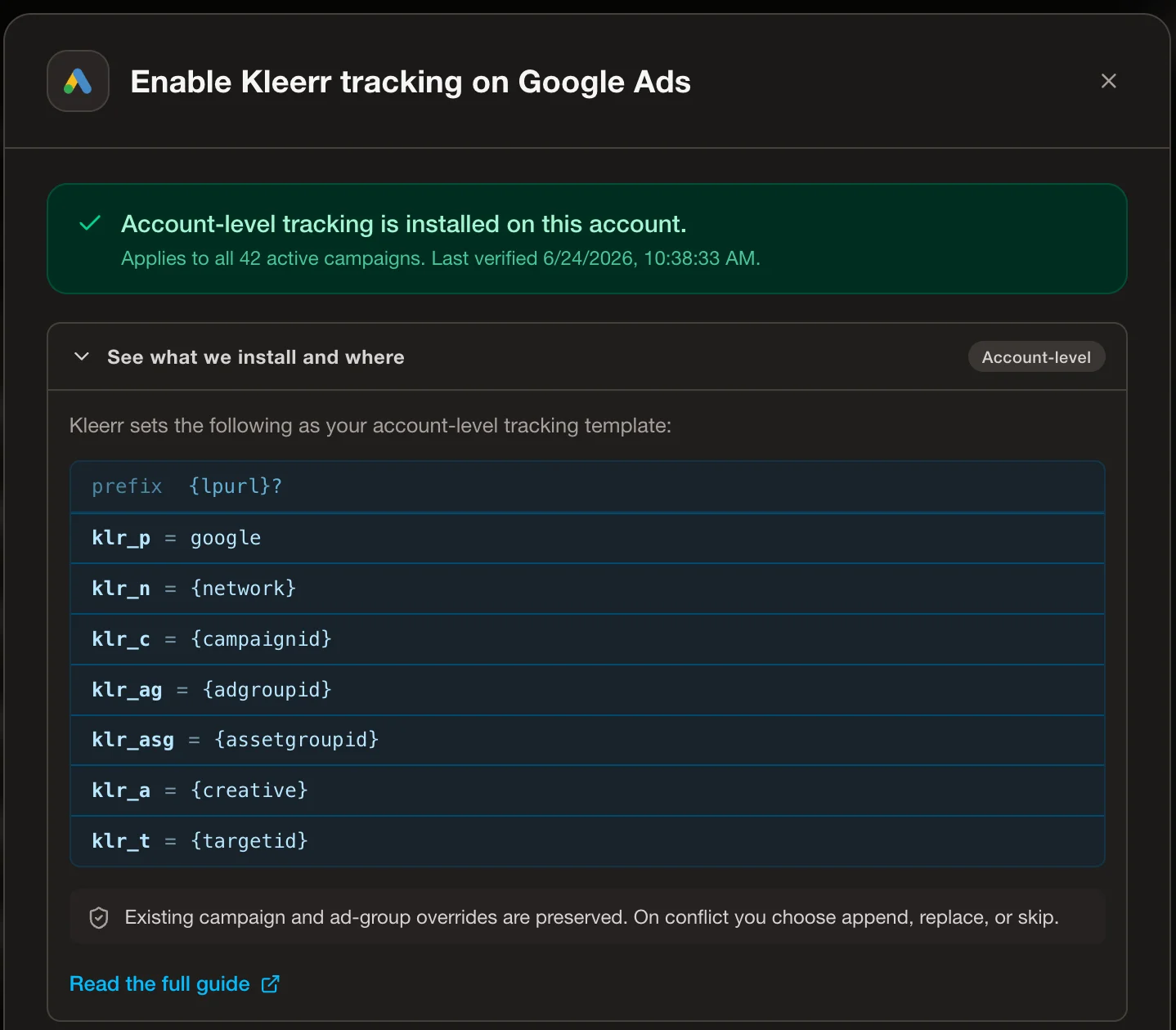
The screenshot above shows Kleerr's Google Ads account-level tracking template.
When installed, Google expands its native macros at click time and appends
Kleerr parameters such as klr_p, klr_n, klr_c, klr_ag, klr_asg,
klr_a, and klr_t to the landing URL.
Why this matters
These parameters are the bridge between an ad click and the rest of Kleerr. Without them, a session may still be categorized from UTMs, click IDs, or referrer data, but Kleerr has less exact campaign, ad group, asset group, creative, and targeting context.
With them installed, Kleerr can:
- verify that paid sessions came from the connected ad account;
- join sessions back to campaign, ad set/ad group, asset group, and creative rows;
- improve Advertising revenue attribution and campaign-level reporting;
- enrich CAPI walkback with stronger campaign and creative context;
- support Signal Recovery when browser-side analytics misses or misclassifies a paid visit;
- identify partial or missing tracking in Ad Manager Setup.
Where they are used
- Ad platforms: Google, Meta, TikTok, and LinkedIn links can carry
klr_*parameters or platform-specific Kleerr parameters. - Builder Tracking Links: generated campaign and event links carry a
kmiparameter that resolves to a tracking-link record. - Traffic categorization: Kleerr parameters are strong source evidence when classifying sessions into platform, channel, source, campaign, and acquisition type.
- Advertising attribution: Kleerr parameters help tie paid sessions back to the ad platform rows used for spend, campaign, ad set, and creative reporting.
What they capture
The exact parameter set depends on the platform, but the goal is consistent:
- platform, such as Google, Meta, TikTok, or LinkedIn;
- network or placement when the platform exposes it;
- campaign ID;
- ad group or ad set ID;
- asset group ID where applicable;
- ad or creative ID;
- targeting or keyword ID where applicable.
These IDs resolve at click time through the ad platform's native macros. Kleerr then joins them to connected platform data such as campaign names, spend, and creative metadata.
How they relate to UTMs and click IDs
Kleerr uses the strongest available evidence when classifying traffic:
- Kleerr parameters are the clearest paid-platform evidence.
- UTMs can describe source, medium, campaign, and acquisition type.
- Click IDs such as
gclid,fbclid, orttclidcan help identify a source or support matching, but they do not always provide enough detail by themselves. - Referrers are useful when URL parameters are missing, but a platform referrer alone does not automatically mean paid traffic.
For the full source priority, see Traffic categorization.
Setup by platform
- Google Ads tracking setup
- Meta tracking setup
- TikTok tracking setup
- LinkedIn tracking setup
- Builder Tracking Links