Attribution models
Kleerr calculates order-level attribution across several models and lookback windows. Pages then choose the model they need for reporting.
For return-visit behavior and traffic source rules, see Session continuation and Traffic categorization. For the order-linking overview, see Attribution overview.
Shared inputs
Every attribution model starts from an eligible session path for an order:
- sessions are ordered from earliest to latest before conversion;
- each session has channel, source, campaign, campaign type, and acquisition type;
- sessions outside the lookback window are excluded;
- continuation handling has already resolved inherited session context;
- repeated continuation visits do not become extra independent source touches.
The examples below use the same four-session path:
Session 1: Google Ads -> Session 2: Meta -> Session 3: TikTok -> Session 4: ChatGPT -> Purchase
NOTE
The default lookback window is 30 days. Attribution is available for these lookback windows: 3, 7, 14, 30, 90, 180, and 365 days. The account default model falls back to Time Decay (30-day) when no account default is saved.
Change both in the dashboard under Settings → Attribution — the Lookback Window and Default Attribution Model fields.
The attribution model and the lookback window are independent settings. Pages honor the selected or account-default model, but they do not all expose a lookback selector: the Advertising page always reads the 30-day-lookback rows while still using the selected model, Marketing Performance revenue by channel uses the account default model, and the Store page initializes from the account default model while honoring the per-account lookback window.
First touch
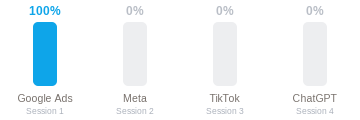
First touch gives 100% of the order credit to the first eligible session.
Example: in the four-session path above, First Touch gives all credit to Session 1, Google Ads.
Use it when you care about acquisition discovery: which channel first brought the buyer into the measurable journey.
Risk: it can over-credit top-of-funnel channels and under-credit high-intent closing channels.
Last touch
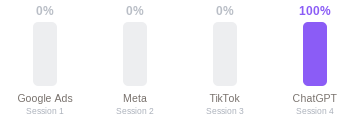
Last touch gives 100% of the order credit to the most recent eligible session.
Example: in the four-session path above, Last Touch gives all credit to Session 4, ChatGPT, the most recent eligible session. If that final visit is a continuation that inherits an earlier source, the resolved inherited source can be used instead.
Use it when you want a simple close-to-conversion view.
Risk: it can over-credit late-stage traffic and under-credit earlier channels that created demand.
Last paid
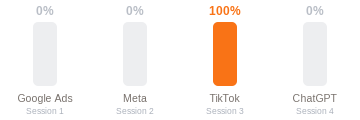
Last paid gives 100% of credit to the most recent paid session when one exists.
Example: in the four-session path above, if the ChatGPT referral is an unpaid AI source, Last Paid gives all credit to Session 3, TikTok, the most recent paid touch.
If there is no paid touch, Last Paid falls back toward the last eligible session. Treat last paid as a paid-media lens, not as a full customer-journey model.
Use it when you are specifically asking, "Which paid channel should receive credit?"
Risk: it intentionally ignores organic and owned touches when paid touches exist.
Linear
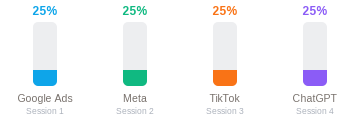
Linear splits credit evenly across eligible sessions.
Example: in the four-session path above, Linear gives equal credit to all four eligible sessions: Session 1 Google Ads 25%, Session 2 Meta 25%, Session 3 TikTok 25%, and Session 4 ChatGPT 25%.
Use it when you want every touch in the path to be represented.
Risk: equal weight can over-credit low-intent touches and under-credit the moments that mattered most.
Time decay
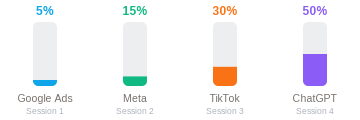
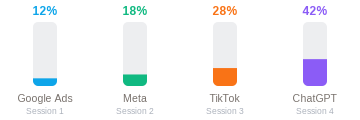
Time decay gives more credit to sessions closer to the order. Kleerr supports 7-day and 30-day half-life variants:
- Time Decay (7-day): credit concentrates faster near the conversion.
- Time Decay (30-day): credit decays more slowly and gives earlier touches more weight.
Example: in the four-session path above, time decay gives the most credit to the recent Session 4 ChatGPT and Session 3 TikTok touches while still preserving some credit for the earlier Session 1 Google Ads and Session 2 Meta touches.
Use it as a balanced default when you want both discovery and closing touches represented without treating all touches equally.
Risk: model weights are mathematical, not causal proof. A touch close to the order is not automatically the reason the order happened.
U-shaped
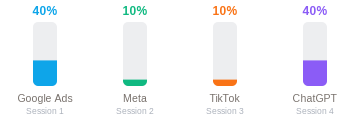
U-shaped emphasizes the first and last eligible sessions. In paths with three or more sessions, Kleerr gives 40% to the first session, 40% to the last session, and splits the remaining 20% across the middle sessions. In two-session paths, it splits 50/50.
Example: in the four-session path above, U-shaped gives 40% to Session 1 Google Ads and 40% to Session 4 ChatGPT, splitting the remaining 20% between Session 2 Meta and Session 3 TikTok (10% each).
Use it when both acquisition and closing matter more than middle touches.
Risk: it can under-credit nurturing channels that sit in the middle of long journeys.
Continuation and multi-touch credit
Continuation is resolved before attribution. A later Direct return can inherit the earlier source when the session chain supports it.
For multi-touch models, continuation sessions are not allowed to multiply credit when there are real acquisition sessions in the journey. A paid click followed by two direct continuation visits still represents one paid source touch, not three separate paid touches. This prevents one source from being inflated simply because the buyer returned directly many times before purchasing.
Example: Meta → Meta continuation → Google has two source touches for multi-touch credit: Meta and Google. Under Linear attribution, Meta receives 50% and Google receives 50%. The continuation preserves the Meta source context, but it is not counted as an extra Meta touch.
Model choice examples
If Google Ads first brought a buyer in, Meta and TikTok nurtured them, and they converted after a ChatGPT referral:
- First touch highlights Session 1, Google Ads.
- Last touch highlights Session 4, ChatGPT (or the resolved inherited source).
- Last paid highlights Session 3, TikTok, the most recent paid touch.
- Linear splits credit evenly across all four sessions.
- Time decay leans toward the later Session 3 and Session 4 touches.
- U-shaped emphasizes Session 1 and Session 4.
For executive reporting, use one model consistently. For diagnostics, compare models to understand whether a channel is mostly discovery, nurturing, or closing demand.