Imagine your cost per lead just dropped. Lead volume is up. The campaign dashboard looks better than it has all quarter.
Then sales opens HubSpot and says the leads got worse.
Both teams can be right. Cost per lead (CPL) is spend divided by lead count. It tells you what each inquiry cost, not what it became. A campaign can get cheaper at the stage you reward while getting worse at the stages that pay the bills.
The outcome you ask the platform to pursue is a budget decision. It influences who sees your ads and how much sales time goes into assessing those inquiries.
My recommendation: reward the ad system for the outcomes you want more of. Track the whole funnel. Train on the deepest trustworthy signal the platform can learn from. Judge the investment on the business result.
This guide shows how to make that choice, how to test it, and how to tell whether it worked.

The short answer
- Track meaningful stages from inquiry to customer, even when you are not bidding on them.
- Train on a supported event that is meaningful, reliable, frequent, fast and matchable enough to learn from. Choose count or value weighting separately.
- Judge on the business outcome, after the acquired leads have had enough time to reach it.
Deeper is a candidate, not a verdict. It still has to survive a fair test.
On this page
- Separate tracking, training and judgment
- Define your lead stages
- Apply the five signal tests
- Compare lead cost with customer economics
- Choose count or value optimization
- Check the platform differences
- Test a new training signal
- Complete the decision worksheet
- Consider objections and organic content
- Make your next decision
Why does the conversion signal change who you reach?
Think about training a dog. If you give a treat every time the dog sits, you get a dog that sits. You do not get a dog that fetches, no matter how much you wanted one.
If every form submission counts equally toward your ad goal, you reward more submissions without explicitly distinguishing their business value. The form that becomes a six-figure deal and the one sales disqualifies can look like the same success event.
Platforms use other information too. Better feedback does not fix every weak offer or slow sales process. It gives the system a clearer business distinction to work with, which you can test rather than assume will help.
Track, train, judge: three jobs that get mixed together
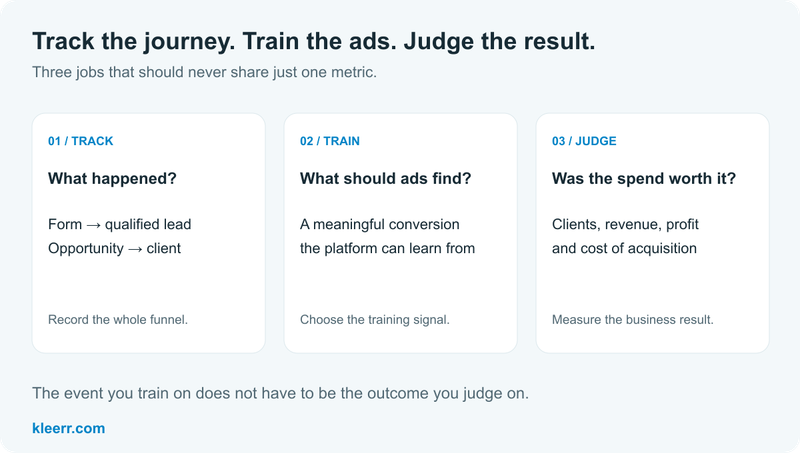
It helps to separate three jobs that often get blended together.
| Job | Question it answers | What you use |
|---|---|---|
| Track | What happened at every stage? | Form submission, valid lead, qualified lead, meeting, opportunity, closed-won, revenue |
| Train | What should the platform find more of? | The best learnable signal for that platform and campaign |
| Judge | Was the spend worth it? | Qualified pipeline, cost per customer, revenue, profit, payback and, where you can test it, incremental impact |
The signal you train on does not have to be the number you judge the business on. You can bid toward qualified leads and still decide whether the campaign deserved its budget by looking at closed-won deals months later.
Keeping these jobs apart prevents two common mistakes. The first is bidding on closed-won revenue because it is the “real” goal, even when it arrives too rarely and too late for bidding to use. The second is judging a campaign on CPL because CPL is the event the platform optimized toward.
Align feedback with the goal: The Oodie
Meta published a case study on The Oodie, an ecommerce brand that wanted first-time buyers. Meta reports an A/B comparison in which campaigns used custom attribution based on The Oodie’s Northbeam data, compared with standard attribution settings. Measured through Northbeam, Meta reports 12% higher return on ad spend from new customers and 15.8% lower acquisition cost.
The goal was first-time buyers. The feedback and the success metric focused on that goal.
What does each lead signal actually tell you?
Start by defining what each candidate event means in your sales process.
| Signal | What it tells you | Strength as a training signal | Main risk |
|---|---|---|---|
| Form submission | Someone gave contact details | Fast and plentiful | Spam, low intent, existing customers and students all count the same |
| Valid lead | The inquiry is real and broadly eligible | A big step up from raw submissions for little delay | May filter obvious poor fits without establishing buying intent |
| Qualified lead | The contact meets agreed fit and intent rules | A strong middle ground when the rule is consistent | Only useful if qualification is applied the same way every time |
| Meeting booked or attended | The prospect took a real next step | High intent, still reasonably quick | Calendar capacity, follow-up speed and no-shows shape it |
| Opportunity | Sales sees a credible deal | Close to revenue | Lower volume, longer delay, depends on how reps create deals |
| Closed-won | A signed or paid customer | Closest to the business outcome | Can be too rare or too slow for bidding |
Stage names are not standard units. MQL (marketing-qualified lead) and SQL (sales-qualified lead) mean whatever your organization says they mean. HubSpot lets you customize lifecycle stages and update them manually or through automation, and its default Opportunity stage means the contact is associated with a deal (HubSpot lifecycle stages). A deal association is weaker evidence than a sales-accepted opportunity with a documented need and a next step. Define the event by what has to be true, not by the label.
Booked and attended meetings are different events. Decide which you mean. A closed-won deal also needs a consistent definition: signed, paid and activated are different milestones.
Keep the counting unit consistent. Several contacts associated with one deal are not several customer acquisitions. Link contacts, companies and deals, count the customer once, and keep new business separate from expansion.
The five tests for a usable training signal
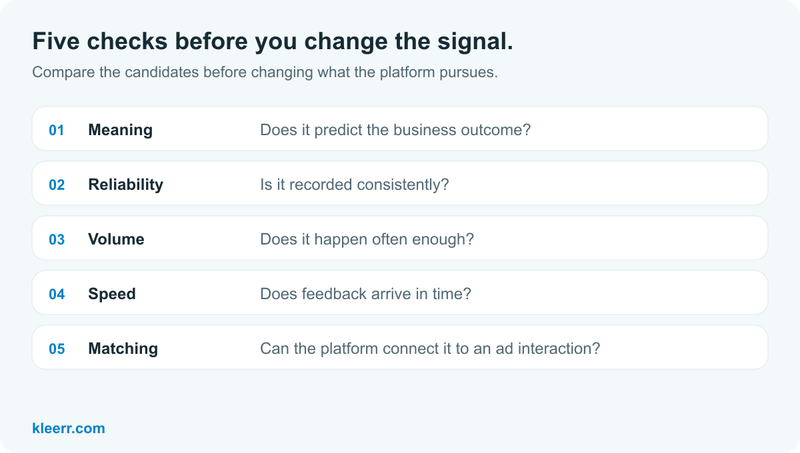
Compare these five tests together. A candidate can be strong on one and weak on another. Weigh the trade-offs for the platform and campaign you are running.
1. Meaning: does it separate good outcomes from bad ones?
A training signal earns its place by predicting the business outcome. If nearly every form submission becomes a legitimate prospect, form submissions may be fine. If most are spam or poor fits, they teach the platform the wrong lesson.
Check this in your CRM before you touch the ad account. Look at older cohorts of contacts and compare how often each candidate event led to an opportunity and a closed-won deal. A qualified lead that converts to opportunity far more often than an unqualified one carries real information. A label that converts at nearly the same rate as everything else does not.
Watch coverage as well as precision. A very strict signal can identify excellent prospects while excluding a large share of the customers you eventually win.
Historical progression helps you choose a candidate. It does not prove that changing the bidding objective will improve results.
2. Reliability: is it recorded the same way every time?
A platform should not learn from a label that changes depending on who touched the record.
If one rep marks every decent conversation as an SQL, another waits for budget confirmation and a third rarely updates stages, the SQL event is noisy. It looks deeper on paper, and it may carry less information than a simple valid-lead event.
The same applies to duplicates, internal test submissions, existing customers, imported lists and recycled leads that re-enter a stage. Before you bid on a downstream stage, make its definition boringly consistent and write it down with a version number.
3. Volume: does it happen often enough to learn from?
Deeper signals can carry more business information while producing fewer observations. They can also become less reliable when sales judgment or inconsistent updates shape them.
No single minimum applies across platforms. Each one publishes its own guidance for each goal, and those numbers differ. The platform section below gives the current figures with their scope.
Count each candidate over recent periods at the level that actually feeds the bidder. A signal that looks plentiful across the whole account can starve once it is split across campaigns, regions and audiences. Weekly consistency matters too. Thirty events in one batch and none for three weeks is a different signal from thirty spread evenly.
4. Speed: does feedback arrive while it is still useful?
A perfect event that arrives three months later can be less useful for active bidding than a good proxy that arrives in three days. Creative, budgets, competition and seasonality all change while the platform waits.
Google says this directly in its value-based bidding guidance: the final sale may be the most accurate signal, but when it is too delayed, an earlier goal such as a qualified lead can be more practical (Google value-based bidding).
Measure delay as a spread, not an average. Record the median and a slower point such as the 80th percentile, from ad click or contact creation to the event. Then separate four clocks that get confused:
- Sales delay: how long the buyer takes to reach the stage.
- Upload delay: how long your system takes to send the event to the platform.
- Platform windows: how old an event can be and still be accepted, attributed or used for optimization.
- Evaluation horizon: how long you must wait before a cohort’s business outcome is known.
A faster integration shortens upload delay. It cannot make a long sales cycle finish sooner.
5. Matchability: can the platform connect it back to an ad interaction?
A well-defined qualified-lead event still does little if most events cannot be matched to the people and clicks that produced them. Matching depends on click identifiers, hashed first-party data such as email, server-side delivery, deduplication and accurate timestamps.
Google’s enhanced conversions for leads uses hashed first-party lead data to connect later CRM outcomes back to ad interactions (Google enhanced conversions for leads). LinkedIn says only matched Conversions API events can be used for attribution and optimization (LinkedIn signal quality).
Matching losses can also bias the sample. If short-cycle customers match well and long-cycle customers do not, the platform may learn from a sample that underrepresents longer buying cycles.
The pipe matters. The signal matters more. A clean server-side connection that sends the wrong event helps the platform optimize the wrong outcome more reliably.
The extra check: are you training on sales execution?
Later stages are not produced by marketing alone. Routing, response time, rep capacity, territory and incentives all shape who becomes an opportunity.
Suppose two campaigns each produce 100 fit-qualified inquiries. Sales promptly follows up on 90 from Campaign A and 45 from Campaign B. If 20% of worked inquiries become opportunities and the rest remain unworked, A records 18 opportunities and B records 9.
The recorded difference follows from unequal sales follow-up. The 55 unworked leads from Campaign B are unknown, not failures.
Before you treat a missing opportunity as bad marketing, compare response time, contact rate, meeting availability, rep-level qualification patterns and stage hygiene. If those differ between the groups you compare, the opportunity event is measuring sales operations as much as lead quality.
When cheaper leads cost more
Suppose you are comparing two setups with equal media spend, consistent definitions and enough time for leads to become customers. Count each customer once at the account level.
A higher cost per lead can be the better buy
Two setups each spend $20,000.
| Setup A | Setup B | |
|---|---|---|
| Leads | 400 | 250 |
| Cost per lead | $50 | $80 |
| Qualified leads | 80 | 100 |
| Cost per qualified lead | $250 | $200 |
| Closed-won customers | 8 | 15 |
| Ad cost per customer | $2,500 | About $1,333 |
Assume $6,000 contribution per customer over the same period, after delivery and servicing costs but before media and overhead. A leaves $28,000 after media spend; B leaves $70,000. Those are contribution figures, not net business profit.
On CPL, A looks better. On customers and contribution per dollar, B looks better. That is why CPL cannot settle the budget decision.
A better qualified-lead cost can hide a worse business result
Keep Setup A as it was: $20,000, 80 qualified leads, 8 customers. Now suppose Setup B produces 100 qualified leads but only 5 customers for the same spend.
Cost per qualified lead (CPQL) still improves, from $250 to $200. Ad cost per customer gets worse, from $2,500 to $4,000. Using the same $6,000 contribution per customer, contribution after media spend falls from $28,000 to $10,000.
A deeper metric can improve while the business gets worse. That is why you train on one signal and judge on another.
Closed-won can arrive too late for bidding
Suppose a B2B software company with a long sales cycle produces 120 leads, 35 MQLs, 12 SQLs, 4 opportunities and 1 or 2 customers each month.
One or two customers a month provide few observations, and timing can rule out the intended route. Suppose a buyer clicks on day 0, qualifies on day 3, becomes an opportunity on day 24 and pays on day 110, with each event exported the next day. Google’s offline import guidance lists 90 days for click-ID imports and 63 days for imports using enhanced-conversion personal data (Google offline conversion FAQ). The day-111 payment upload falls outside both windows for that route.
Keep the payment in your business evaluation. For training, compare an earlier qualification event with the platform’s eligibility, usable volume and timing requirements. Combining campaigns may improve volume where the setup permits it; it cannot repair an unreliable qualification rule.
When should you use value instead of a single stage?
Value is a separate decision from event depth. You can count qualified leads equally or weight them by estimated value. A larger potential contract does not automatically mean greater expected value: win probability and servicing costs matter too.
Where the platform and your integration support it, value-based bidding lets you pass a number with each conversion. Google supports value-based bidding with real or proxy values and recommends at least two distinct values (Google value-based bidding). LinkedIn supports conversion value optimization for website conversion campaigns (LinkedIn conversion value optimization).
Three rules keep values honest.
Use only what you know at the moment you send the event. If you score historical leads using deal amounts that were only known later, your validation will look better than reality.
Label what the number is. Pipeline amount is not expected revenue. Expected revenue is not collected revenue. Revenue is not profit. A points-based lead score is not a dollar value.
Do not stack full values across stages. If one journey sends $200 at lead, $1,000 at qualification and $5,000 at closed-won, summing them reports $6,200 for a $5,000 customer. Pick one valued event, or design and test a scheme that avoids double counting.
Count-based optimization is a reasonable starting point when values cannot yet be estimated reliably. Consider value weighting when meaningful differences are supported by mature outcomes and your platform connection can express them. A bad lead score with a dollar sign attached is still a bad signal.
How do the major platforms handle deeper lead signals?
The documented workflows below have different eligibility requirements. Check the goal, event source and bidding mode available in your account before choosing a signal.
| Platform | Deeper-signal option | What the current guidance says | What it means for you |
|---|---|---|---|
| Google Ads | Qualified and converted lead goals, enhanced conversions for leads, value-based bidding | Choose one lead-to-sale stage for value bidding and report outcomes often. For Search and Shopping value bidding, Target ROAS guidance cites at least 15 conversions in the previous 30 days at the conversion-tracking level (value-based bidding, qualified and converted leads) | Audit which actions the campaign actually bids on. Primary actions count for bidding when their goal is selected, and custom goals can make secondary actions biddable too (conversion goals, custom goals) |
| Meta | Conversions API for CRM and the Conversion Leads performance goal | Meta positions its CRM integration around optimizing for lead quality rather than only lead volume (Meta Blueprint) | Through HubSpot’s native connector, the documented lifecycle route uses Instant Forms with the Conversion Leads goal (HubSpot Meta integration). Website-event optimization is a separate path |
| Qualified leads optimization for Lead Gen Forms, plus conversion value optimization for website conversions | Qualified-lead data comes through the Conversions API or CRM Sync. LinkedIn recommends at least five qualified leads within two weeks and sharing qualification data as soon as it is available (qualified leads goal). Launch needs at least one qualified lead and Maximum Delivery bidding (setup) | Qualified-lead optimization is a specific Lead Gen Form workflow. A generic lifecycle export only helps if it maps to the qualified-lead conversion | |
| TikTok | Signal optimization for lead generation using Pixel or CRM postbacks such as Qualified Lead, Sales Opportunity and Purchase | Pixel event choice is set per campaign. CRM optimization uses an account-level starting stage and combines eligible later stages (TikTok signal optimization) | An account-level CRM setting affects every campaign using it, which matters when you design a test |
Two HubSpot details deserve attention because they change what the platform actually receives.
First, HubSpot’s Google Ads connector sends lifecycle stage changes that happen after you create the conversion event, and a contact that moves through several configured stages can generate several events (HubSpot Google Ads integration). Audit every action the campaign uses for bidding, including actions in custom goals. Choose deliberately whether it should optimize toward one stage or a supported combination, rather than counting repeated funnel progress as separate acquisitions.
Second, a connector that brings leads into HubSpot is not the same as one that sends quality back out. TikTok’s HubSpot guide documents syncing Instant Form leads into HubSpot (TikTok HubSpot integration). That alone does not set up a return path for qualified-lead or opportunity events. Confirm the direction of every connection.
Keep business definitions consistent across platforms. The training event can still differ because eligibility, volume and timing differ. Document which outcomes each platform receives and which can affect bidding. Do not selectively export only favorable outcomes to improve the report.
How to test a new training signal
Changing the signal is a bet. Treat it like one, with a stated hypothesis, a fair comparison and a rule for what you will do with the answer.
Step 1: write down what you are comparing
- Current training signal: for example, every form submission, counted.
- Candidate training signal: for example, qualified lead, defined as a contact who meets the documented fit rules and is accepted by sales under the normal follow-up process, version 2.
- Business KPI: the outcome that decides the test, such as ad cost per closed-won customer or qualified pipeline per dollar. Pick one primary measure.
- Mature comparison window: how long a cohort needs before most of its deals have closed or been lost. Base it on your own historical lead-to-close delay, not on a platform’s learning period.
- Hypothesis: “If we optimize for qualified leads instead of all leads, cost per qualified lead will fall without shrinking qualified pipeline, and ad cost per customer will not get worse once cohorts mature.”
Step 2: validate the event before you bid on it
Reconcile a sample end to end: the action in HubSpot, the lifecycle or deal history, the outbound event, what the platform accepted and what it matched. Look for duplicates, repeated stage changes, backfilled records and export timestamps standing in for real event times.
Step 3: run an observation-only shadow period
Send the candidate event to the platform without making it the bidding goal, where the platform allows that. This lets you measure real volume, delay and match coverage before anything changes.
A shadow run checks the feed before you deliberately change the bidding objective. It does not establish whether bidding toward the candidate improves business results. On Google, a secondary action included in a selected custom goal still participates in bidding (Google custom goals).
Google’s separate value-bidding preparation guidance applies once you are bidding toward the intended conversion goal. It recommends uploading values for three weeks or one to two conversion cycles, whichever is longer, before activating value bidding (Google value-based bidding).
Step 4: change one thing
Change the training signal. Keep budget, creative, targeting, landing pages, qualification rules and sales routing as stable as you can. If you switch the event, restructure campaigns and launch new creative on the same day, you will not know what caused the result.
Test event choice and value weighting separately. “Does optimizing for qualified leads beat optimizing for leads?” is one question. “Does weighting qualified leads by expected value beat counting them?” is another.
Step 5: use a real comparison, not a before-and-after
A before-and-after comparison mixes your change with seasonality, competition and everything else that moved. Use a platform experiment only when it supports the specific change and keeps the comparison groups separate. Google’s value-bidding experiment guidance generally keeps conversion actions unchanged. Do not assume that a supported bidding-strategy test also supports changing the conversion event; confirm that the experiment fits the change you want to test (Google experiment guidance).
Check isolation before you trust a split. On TikTok, the CRM starting stage is set at account level, so two campaigns in the same account may not be independent test groups.
Know what the experiment answers. A bidding experiment compares two advertising policies under the test’s budget and delivery settings. It does not tell you whether the ads caused sales that would not have happened anyway. That needs a holdout, where some audience or region sees no ads. Attribution reports assign credit, which is different from incremental impact. Research comparing observational methods with randomized Facebook ad experiments found the observational estimates often failed to match the experimental results (Gordon et al., 2019).
Step 6: judge on mature outcomes
Early numbers move first. Raw CPL may rise and lead volume may fall. Neither is a verdict. Treat early quality metrics as provisional and wait for the comparison window you set in step 1.
In HubSpot, the same calendar filter can describe different groups. Contact Create Attribution filters by contact creation, Deal Create Attribution by deal creation, and Deal Revenue Attribution by close date. Follow the acquired leads through their outcomes instead of comparing unrelated monthly totals (HubSpot attribution reports). Its attribution terminology for lead creation refers to contact creation, not qualification (HubSpot attribution definitions).
Step 7: decide in advance what each result means
- Keep the change if mature evidence supports a worthwhile improvement in the primary business KPI, with enough observations to distinguish it from noise and without unacceptable damage to qualified pipeline volume, sales workload or deal size.
- Reverse it if business outcomes worsen, matching breaks, volume collapses below what the platform can learn from, or the definition drifts.
- Call it inconclusive if the difference is small or the sample is thin. Inconclusive does not mean the two setups are equal. Keep the simpler setup, gather more data and test again.
Write the decision down with the date, the definition version and what would make you revisit it.
The signal decision worksheet
Fill in one row per candidate signal per platform. Use mature cohorts for outcome questions and recent periods for feed health, and record both date ranges. Do not collapse the answers into a single score.
| Field | What to enter | Why it matters |
|---|---|---|
| Business goal | The outcome and time horizon, such as new customers at an acceptable cost within 12 months | Sets the yardstick for every other answer |
| Unit | Contact, company or deal | Several contacts on one deal are not several customers |
| Candidate event and definition | Exact trigger, exclusions and version | Ambiguous stage names fail here |
| Owner and update method | Who or what changes the stage, and how | Manual, inconsistent updates weaken reliability |
| Sales dependencies | Routing, response time, rep discretion, capacity | Flags differences that can look like lead quality |
| Meaning | Opportunity and closed-won rate for contacts with and without this event, in mature cohorts | Shows whether the event predicts the outcome |
| Volume | Unique events over the last 14, 30 and 90 days at the level that feeds the bidder | Shows whether the platform has enough to learn from |
| Delay | Median and 80th-percentile time from click or contact creation, plus upload delay | Separates sales delay from integration delay |
| Platform fit | Goal, campaign type, bidding mode and windows for this platform | Unknown eligibility counts as not ready |
| Connection | Which tool sends the event, which identifiers, whether values and corrections are supported | Incoming lead sync alone is not enough |
| Match coverage | Share of sent events the platform accepts and matches, where visible | Low or skewed matching starves or biases learning |
| Value | Whether values differ enough to matter, and what each number represents | Prevents pipeline amounts posing as revenue |
| Test design | Comparison method, what stays fixed, primary KPI and comparison window | Without isolation, there is no winner to declare |
| Decision | Use now, shadow and repair, test, keep current, or reverse | Records the call and who owns it |
Finish each completed row with a one-line decision record:
For [platform and campaign], train on [event and definition version], counted or valued, because [evidence]. Judge it on [business KPI] for cohorts at least [comparison window] old. Keep tracking [other stages] for diagnosis. Revisit if [feed failure, definition change, economics change or test result].
When two candidates both hold up, prefer the deeper one only if its extra predictive value is worth the lower volume and longer delay. When none of the later stages holds up, the answer may be to fix CRM definitions, improve match coverage, consolidate campaigns or stay with a cleaner early signal such as a valid lead. Training on closed-won anyway is not a plan.
Three objections worth taking seriously
“Revenue is the real goal. Why use a proxy?”
Because an outcome can be right for judging the business and unusable for the chosen bidding setup. Keep measuring customers and their economics. Test whether the earlier event helps you acquire more valuable business; do not let its lower cost become the verdict.
“Qualified leads let sales bias leak into marketing.”
They can. Define qualification, audit the records and compare similar sales treatment. If the label mostly reflects which rep had time to follow up, repair that process before teaching a bidder to pursue it.
“We connected the CRM. Isn't that enough?”
The connection transports your definition of success. It does not decide whether that definition is useful. Check the event, direction of delivery, matching and actions actually used for bidding, including custom goals.
Where organic content fits
Content can help prospects understand the offer, answer objections and assess fit before they inquire. Likes and views can help you refine a message, but they are not interchangeable with qualified buying intent.
Use content interactions and self-reported discovery alongside CRM outcomes. Only consider an engagement event as a training proxy when you have evidence of its relationship to the business result. More engagement volume alone is not enough.
Where Kleerr fits
Kleerr’s HubSpot integration enriches contacts with attribution and supports deal-to-source correlation. Its advertising view brings together Meta, Google, LinkedIn and TikTok. That helps you investigate marketing sources alongside CRM outcomes; the comparison still needs clear contact-to-deal associations and enough time for outcomes to develop.
It does not replace the judgment calls in this guide. Defining qualification, agreeing it with sales and deciding what each platform should train on remain your decisions.
Your next step
Pick one platform and one campaign. Fill in the worksheet for three candidates: your current conversion event, a valid-lead event and a qualified-lead event. Pull recent counts and delays from HubSpot, plus older cohorts that have had enough time to reach your chosen business outcome. Check what the campaign is actually bidding on today.
Before changing bidding, make three decisions:
- What exact event will the platform pursue?
- What business outcome will decide whether the change helped?
- What evidence would make you keep, reverse or call the result inconclusive?
If the candidate is eligible and the feed is dependable, test it using a supported comparison. If not, fix the weak link first.
Reward what you want more of. Then check that you got it.
Read the companion guide: How to Know if Your Marketing Is Actually Working.