
Updated July 13, 2026.
The best Rockerbox alternatives depend on the marketing decision your team needs to make. Kleerr fits Shopify revenue verification and action. Northbeam fits advanced paid-media measurement. Polar Analytics fits broad commerce data. Triple Whale fits an ecommerce suite. Other tools focus on long funnels, customer journeys, or detailed ad tracking.
TL;DR
>
> - Keep Rockerbox if your brand needs one measurement system for digital ads, direct mail, TV, streaming, affiliates, and other offline channels.
> - Compare Kleerr if your Shopify team needs to separate new-customer revenue from repeat-order credit, reconcile platform claims to real orders, and act on the result.
> - Compare Northbeam for advanced paid-media measurement, Polar Analytics for a wider commerce data platform, and Triple Whale for an all-in-one ecommerce suite.
> - Choose by the decision you need to make, not by the number of features on the pricing page.

Who should keep Rockerbox, and who should compare alternatives?
Rockerbox remains a strong fit in 2026 for brands measuring complex online and offline media in one system. Shopify DTC teams should compare alternatives when their main problem is narrower, such as verifying platform claims against orders, improving ecommerce reporting, tracking long funnels, or sending cleaner customer signals back to ad platforms.
Rockerbox describes its platform as a unified approach to measuring search, social, affiliates, display, streaming video, linear TV, and direct mail. Rockerbox combines a marketing data foundation with multi-touch attribution, marketing mix modeling, incrementality testing, and scenario planning, according to its channel measurement page.
That breadth matters when a brand cannot connect every sale to a digital click. Rockerbox also documents direct-mail measurement through first-party data, address matching, customer journeys, and MMM on its direct-mail measurement page.
A focused alternative may fit better when a Shopify DTC team has a simpler media mix and a sharper question:
- Which paid spend created a new customer?
- Which channel took credit for a repeat order?
- Which platform claim matches refund-aware Shopify revenue?
- Which customers should paid campaigns exclude?
- Which verified customer groups should seed acquisition audiences?
What are the best Rockerbox alternatives in 2026?
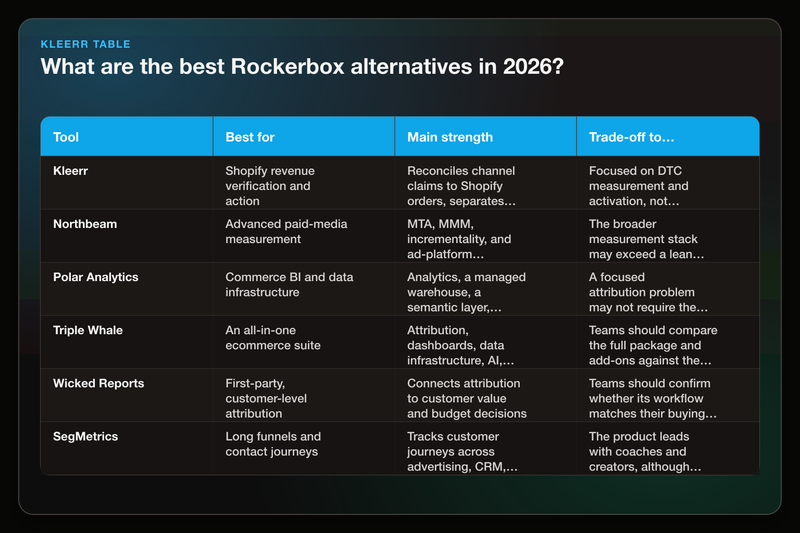
The best Rockerbox alternatives in 2026 are Kleerr, Northbeam, Polar Analytics, Triple Whale, Wicked Reports, SegMetrics, and RedTrack. Each product serves a different job. The right shortlist depends on whether your team needs Shopify verification, advanced measurement, commerce BI, a broad ecommerce suite, long-funnel analysis, or ad-level tracking.
| Tool | Best for | Main strength | Trade-off to evaluate |
|---|---|---|---|
| Kleerr | Shopify revenue verification and action | Reconciles channel claims to Shopify orders, separates new from repeat customers, and builds usable audiences | Focused on DTC measurement and activation, not offline media measurement |
| Northbeam | Advanced paid-media measurement | MTA, MMM, incrementality, and ad-platform optimization tools | The broader measurement stack may exceed a lean team’s needs |
| Polar Analytics | Commerce BI and data infrastructure | Analytics, a managed warehouse, a semantic layer, activations, and AI tools | A focused attribution problem may not require the full data platform |
| Triple Whale | An all-in-one ecommerce suite | Attribution, dashboards, data infrastructure, AI, and optimization products | Teams should compare the full package and add-ons against the specific job they need |
| Wicked Reports | First-party, customer-level attribution | Connects attribution to customer value and budget decisions | Teams should confirm whether its workflow matches their buying cycle and reporting needs |
| SegMetrics | Long funnels and contact journeys | Tracks customer journeys across advertising, CRM, email, and payment systems | The product leads with coaches and creators, although it also supports ecommerce |
| RedTrack | Detailed ad tracking and conversion signals | Tracking, attribution, CAPI, automation, and campaign management | Teams needing offline measurement or a broad commerce data platform should confirm coverage |
How do the leading Rockerbox alternatives compare in detail?
Each Rockerbox alternative replaces a different part of the Rockerbox job. Kleerr narrows the focus to Shopify revenue and customer action. Northbeam emphasizes advanced media measurement. Polar Analytics and Triple Whale provide broader ecommerce platforms. Wicked Reports, SegMetrics, and RedTrack focus on customer value, long journeys, or detailed advertising operations.
1. Kleerr: best for Shopify revenue verification and action
Kleerr fits Shopify DTC brands that cannot tell which ad spend created new customers and which spend received credit for repeat orders. Kleerr starts with first-party events and refund-aware Shopify revenue, then connects platform claims to customers, sources, click IDs, and order-level evidence.
The result is a verified view of channel and campaign performance. Kleerr also turns verified customer states into recent-buyer exclusions, high-value audience seeds, lookalikes, and basic actions through the brand’s existing tools. The Kleerr platform is built for teams that need a data-team answer without running a warehouse or hiring analysts.
In one Shopify audit, GA4 placed 40,071 sessions in “Unassigned.” After Kleerr reprocessed the customer journeys using first-party evidence, 3,097 sessions remained unassigned. The campaigns the brand was preparing to cut were among those creating demand, according to Kleerr’s published ecommerce audit summary. This was one brand audit, not a market benchmark.
Best for: Shopify DTC brands spending meaningful money on Meta, Google, or TikTok that need to verify new-customer performance and put the result to work.
Trade-off: Rockerbox is a better fit when direct mail, TV, streaming, and other offline channels are central to the measurement plan.
2. Northbeam: best for advanced paid-media measurement
Northbeam fits brands that want multi-touch attribution, media mix modeling, incrementality, and direct integrations that improve ad-platform inputs. Northbeam also provides product analytics, creative analytics, correlation analysis, and performance benchmarks, according to the Northbeam product site.
Northbeam’s breadth can help a sophisticated paid-media team study demand creation across channels and models. Northbeam’s trade-off is focus. A lean Shopify team should decide whether it needs the full measurement suite or a narrower answer about platform claims, new-customer revenue, and verified orders.
Best for: Teams with large paid-media programs and the resources to use several measurement methods.
Trade-off: A focused Shopify verification workflow may be easier for a smaller growth team to adopt.
3. Polar Analytics: best for commerce BI and data infrastructure
Polar Analytics fits ecommerce brands that want analytics, data infrastructure, activations, and AI tools in one platform. Polar describes its product as an all-in-one data stack with a managed warehouse, connectors, a semantic layer, first-party tracking, incrementality testing, advertising signals, and audience activation on the Polar Analytics product site.
Polar Analytics’ wider data foundation can support reporting beyond paid-media attribution. The platform can also suit agencies or brands that want a common commerce data model across several workflows.
Polar Analytics’ trade-off is scope. A Shopify team trying to answer one budget question may not need a warehouse, AI agents, and a broad business intelligence layer.
Best for: Ecommerce teams that want one data platform for reporting, analysis, activation, and AI use cases.
Trade-off: A narrower verification product can reduce complexity when the immediate problem is deciding which ad spend to trust.
4. Triple Whale: best for an all-in-one ecommerce suite
Triple Whale fits ecommerce teams that want attribution, business dashboards, data infrastructure, AI tools, and advertising optimization products in one ecosystem. Triple Whale’s public pricing page lists products for attribution, AI analysis, data warehousing, server-side signals, creative analysis, and unified measurement on its current plan structure.
A broad suite can offer better value when a team uses most of those capabilities. A focused product can offer better value when the team only needs one job done well.
Shopify teams should compare the exact plan, add-ons, revenue tier, and required workflow before deciding. Product packaging can change, so the vendor’s current pricing page should control the cost comparison.
Best for: Ecommerce teams that want a broad analytics and AI command center.
Trade-off: Teams focused on reconciling platform claims to orders may pay for a wider product than the immediate job requires.
5. Wicked Reports: best for customer-value attribution
Wicked Reports fits teams that want first-party attribution tied to customer value and marketing decisions. Wicked Reports presents its platform as a measure, signal, and action system that supports attribution, funnel analysis, conversion signals, and logged budget decisions on the Wicked Reports product site.
Wicked Reports’ approach can help brands with repeat purchases or longer customer relationships connect acquisition decisions to later revenue. Shopify teams should still inspect the attribution method, required setup, reporting windows, and activation workflow before switching.
Best for: Teams that want attribution connected to customer value and budget decisions.
Trade-off: Brands should confirm whether the workflow fits a fast Shopify purchase cycle or a longer funnel.
6. SegMetrics: best for long funnels and contact journeys
SegMetrics fits businesses that need to connect advertising, email, CRM activity, payments, and customer journeys over a longer sales process. SegMetrics leads with marketing analytics for coaches and creators, while also listing ecommerce, SaaS, agencies, and information products as supported use cases on the SegMetrics product site.
The contact-level journey view can help when a sale follows a long nurture sequence rather than a short ecommerce visit. Shopify brands should compare that strength against their actual buying cycle.
Best for: Coaching, creator, education, subscription, or funnel-led businesses with long nurture paths.
Trade-off: A Shopify-first platform may fit better when orders, refunds, repeat status, and paid acquisition are the core data objects.
7. RedTrack: best for detailed ad tracking and conversion signals
RedTrack fits media buyers and agencies that want tracking, attribution, Conversion API connections, rules-based automation, and campaign management for paid traffic. RedTrack’s site lists use cases for ecommerce brands, affiliate media buyers, and agencies, plus connections to ad platforms, ecommerce systems, CRMs, analytics tools, and automation destinations on the RedTrack website.
RedTrack’s focus can suit teams that manage campaigns closely and want the tracking layer connected to ad operations. Brands should confirm channel coverage and reporting methods against their own stack.
Best for: Performance teams that prioritize ad-level tracking, conversion signals, and campaign operations.
Trade-off: Rockerbox remains the stronger shortlist candidate when broad offline and cross-channel measurement drives the buying decision.
Check your own numbers before switching: Run a free Kleerr account audit to compare ad-platform claims with Shopify orders and see whether the gap would change a budget decision.
When is modeled attribution better than verified revenue?
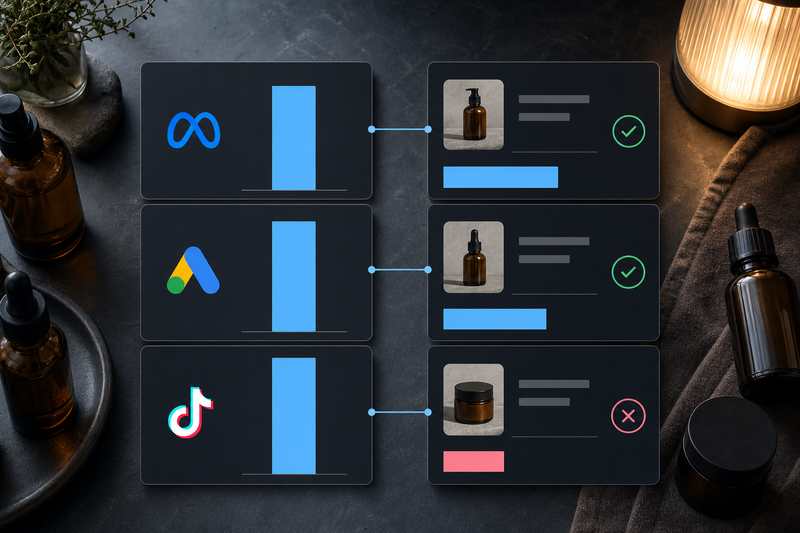
Platform dashboards and modeled attribution are faster when a team needs an immediate directional view. Platform reporting already sits inside the ad account, while modeling can estimate credit when deterministic evidence is missing. Verified revenue becomes more useful when a Shopify team must defend a budget move against completed orders, refunds, and customer status.
A daily campaign check does not require a perfect revenue ledger. Meta and Google can surface delivery changes, creative fatigue, and conversion trends faster than a separate reconciliation process.
Modeling also helps with channels that lack a direct path to purchase. TV, streaming, direct mail, and view-based advertising can influence demand without producing a click that connects neatly to an order. Rockerbox’s broad measurement approach is valuable for that job.
The standard should change when real money moves between channels. A Shopify DTC team deciding where to add or remove budget should ask:
- Does claimed revenue reconcile to Shopify?
- Does the figure account for refunds?
- Did the spend create a first-time customer or receive credit for a repeat order?
- Can the team trace the aggregate result back to orders and source evidence?
- Will the finding change an audience, signal, or budget decision?
Verified revenue does not remove every judgment call. Verified revenue gives the team a defensible ledger before it makes a budget decision.
How should a Shopify DTC team choose a Rockerbox alternative?
A Shopify DTC team should choose a Rockerbox alternative by defining the decision, required channels, proof standard, and action workflow before comparing features. For brands doing $10M to $50M in annual revenue without a data team, the best product is the one operators can trust and use every week.
- Write down the budget question. Decide whether the team needs offline measurement, Shopify order verification, broader BI, long-funnel attribution, or ad-level tracking.
- List every channel that matters. A brand running direct mail and streaming video has a different measurement problem from a Shopify brand running Meta, Google, TikTok, and Klaviyo.
- Define the revenue ledger. Decide whether the team will compare results against gross platform conversions, completed Shopify orders, refund-aware revenue, contribution margin, or customer lifetime value.
- Separate measurement from causation. Attribution allocates credit under a rule. Incrementality testing estimates what changed because of an action. Do not treat an attribution model as proof of lift.
- Inspect the evidence. Ask whether a channel total can be traced to orders, customers, click IDs, source evidence, and the rule used to assign credit.
- Test the action layer. Confirm whether the result can update budgets, exclusions, customer segments, lookalike seeds, or conversion signals without a manual spreadsheet process.
- Count the operating cost. Include onboarding, analyst time, warehouse work, integrations, add-ons, and weekly maintenance. Subscription price alone does not capture total cost.
Are Rockerbox alternatives cheaper?
Some Rockerbox alternatives can cost less, but no honest comparison can answer that without the brand’s channels, volume, plan, and implementation needs. A focused Shopify tool may require less operational work. A broader suite may deliver better value when the team uses its measurement, reporting, data, and activation features together.
Compare the full cost of getting a trustworthy answer:
| Cost area | What to check |
|---|---|
| Subscription | Base plan, usage limits, revenue tiers, and ad-spend ceilings |
| Add-ons | MMM, incrementality, signal syncing, advanced reporting, and extra brands |
| Implementation | Setup fees, onboarding work, tagging, and historical imports |
| Data work | Warehouse, SQL, analysts, and custom pipelines |
| Operations | Weekly reporting, reconciliation, exports, and audience maintenance |
| Switching risk | Lost history, retraining, parallel measurement, and team adoption |
Ask each vendor for a quote based on the same scope. Include the same channels, data history, brands, destinations, and support level. A cheaper quote is not cheaper if the team must rebuild the missing workflow by hand.
What should a brand test before switching from Rockerbox?
A brand should test data completeness, order reconciliation, channel classification, customer status, auditability, and usable actions before switching from Rockerbox in 2026. Run the current system and the alternative in parallel long enough to compare the same dates, attribution windows, orders, refunds, and campaign inputs.
Use a short scorecard:
| Test | Question to answer |
|---|---|
| Revenue reconciliation | Do channel totals reconcile to the selected Shopify revenue ledger? |
| Customer status | Can the tool separate first-time customers from repeat buyers? |
| Source recovery | Can the tool explain missing or misclassified sessions with evidence? |
| Audit trail | Can an operator trace a total back to orders and customer journeys? |
| Model clarity | Can the team explain the attribution rule to finance or leadership? |
| Channel coverage | Does the product cover every paid, owned, and offline channel that matters? |
| Actionability | Can the result change budgets, exclusions, audiences, or signals? |
| Operating burden | Can the current team run the workflow without added analysts or warehouse work? |
A parallel test will produce different numbers across tools. The goal is not to find matching dashboards. The goal is to understand why the numbers differ and which method supports the decision your team must make.
Frequently asked questions about Rockerbox alternatives
Rockerbox alternatives serve several different jobs in 2026. Kleerr focuses on verified Shopify revenue and customer action. Northbeam focuses on advanced paid-media measurement. Polar Analytics and Triple Whale provide broad ecommerce platforms. Wicked Reports, SegMetrics, and RedTrack cover customer value, long funnels, or detailed advertising operations.
What is the best Rockerbox alternative for Shopify?
Kleerr is a strong Rockerbox alternative for Shopify DTC brands that need to reconcile platform claims to orders, separate new customers from repeat buyers, and use verified customer data for audiences and suppression. Rockerbox remains stronger when offline media measurement is central.
What is the best Rockerbox alternative for enterprise measurement?
Northbeam belongs on the shortlist for teams seeking MTA, MMM, incrementality, and advanced paid-media analysis. Polar Analytics belongs on the shortlist when commerce BI, a managed warehouse, activations, and a semantic layer matter alongside measurement.
Is Rockerbox good for ecommerce?
Rockerbox supports ecommerce measurement, but ecommerce is only one part of its broader cross-channel scope. Rockerbox makes the most sense when an ecommerce brand also needs to measure direct mail, streaming, TV, affiliates, or other channels that do not fit a simple click-to-order path.
What is the difference between Rockerbox and Kleerr?
Rockerbox provides broad cross-channel measurement across digital and offline media. Kleerr focuses on Shopify DTC brands that need to reconcile ad claims to refund-aware orders, identify new versus repeat customers, and turn verified customer data into exclusions, audiences, and basic actions.
Can Rockerbox alternatives measure incrementality?
Some Rockerbox alternatives offer incrementality testing, but attribution and incrementality are different jobs. Attribution assigns credit under a model. Incrementality estimates what would have happened without the marketing action. Confirm the exact method, test design, and current availability with each vendor.
Should a brand replace Rockerbox because the numbers differ from Shopify?
No. Different totals do not prove that Rockerbox or Shopify is wrong. The systems can use different revenue definitions, attribution windows, identity rules, refunds, and channel classifications. Reconcile those definitions first, then test whether another method produces a more defensible budget decision.
Can a Shopify brand use Rockerbox with Klaviyo?
A Shopify brand should confirm current integration scope with Rockerbox before buying. The larger question is whether the measurement system can connect owned-channel activity, paid-media claims, customer status, and completed Shopify orders without counting the same revenue several times.
How was this Rockerbox alternatives comparison researched?
This 2026 comparison uses vendor product and pricing pages checked on July 13, 2026. The comparison groups products by the marketing job each vendor describes, then states the practical trade-off for a Shopify DTC team. Features and prices can change, so buyers should confirm current scope directly with each vendor.
Disclosure: Kleerr makes one of the tools included in this comparison.
Sources checked:
- Rockerbox, channel measurement and direct-mail measurement.
- Northbeam, product site.
- Polar Analytics, product site.
- Triple Whale, pricing and plan structure.
- Wicked Reports, product site.
- SegMetrics, product site.
- RedTrack, product descriptions and solutions listed on its website.
See what your ad budget is buying
Kleerr can show a Shopify DTC team which paid spend created new customers, which received credit for repeat orders, and how each channel claim compares with real revenue. Book a Kleerr ecommerce demo to review the workflow using your own stack.
About the author
Daniel Pisterzi is the founder of Kleerr, a marketing analytics company for Shopify DTC brands. Daniel works on first-party measurement, signal recovery, revenue reconciliation, and the budget and audience decisions that follow from verified ecommerce data.