Updated July 14, 2026.
The best Cometly alternatives in 2026 depend on the revenue event your team needs to trust. Cometly fits B2B SaaS teams connecting ads to pipeline and closed-won revenue. Shopify DTC brands, omnichannel retailers, creators, and agencies may need a tool built around orders, refunds, offline media, or longer buying journeys.
TL;DR
>
> - Keep Cometly if your main job is connecting ads to leads, pipeline, subscriptions, and closed-won revenue across a B2B SaaS stack.
> - Consider Kleerr for Shopify revenue verification and audience activation, Triple Whale for broad ecommerce analytics, Northbeam for a full measurement suite, and Polar Analytics for ecommerce data infrastructure.
> - Consider Rockerbox for online and offline media, Wicked Reports for long-window attribution, SegMetrics for coaches and creators, and RedTrack for affiliate or multi-source tracking.
> - Choose by the budget decision you need to make, not by which vendor has the longest feature list.

Why look for a Cometly alternative?
A team should compare Cometly alternatives when Cometly’s B2B SaaS focus does not match its business model, revenue ledger, or media mix. Shopify DTC brands may care more about orders, refunds, and new customers. Other teams may need offline channel measurement, ecommerce BI, long nurture analysis, or affiliate tracking.
Common reasons to compare include:
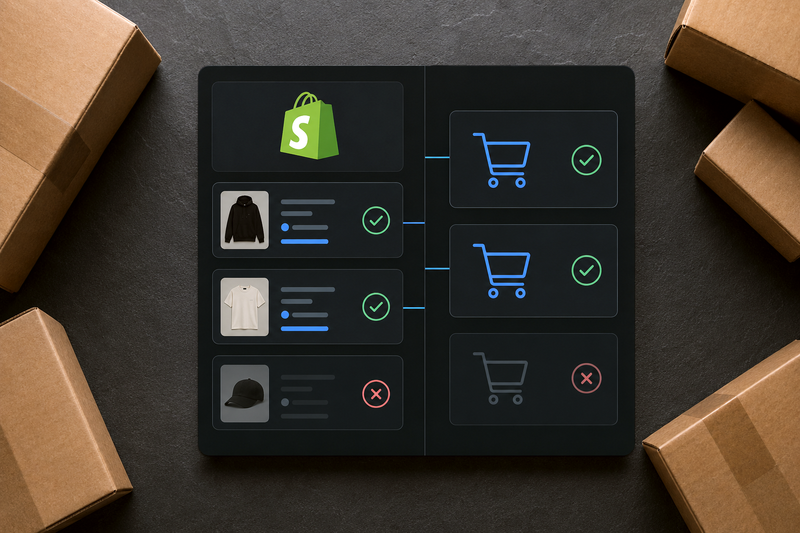
- Shopify is the revenue ledger. A DTC team needs to connect ad claims to actual orders, refunds, repeat purchases, and customer value.
- The business needs broader ecommerce reporting. Finance, inventory, retention, and merchandising can matter as much as ad attribution.
- The media mix extends beyond digital ads. TV, streaming, direct mail, affiliates, and other channels need different measurement methods.
- The buying journey is specialized. A coaching funnel, subscription product, or phone-assisted sale does not behave like a standard ecommerce checkout.
- The team needs action after measurement. Audiences, conversion signals, suppression, and campaign controls can matter more than another dashboard.
Cometly may remain the right choice when none of these gaps apply.
Is Cometly still a good choice in 2026?
Cometly remains a strong option in 2026 for B2B SaaS teams that need to connect advertising with leads, product activity, subscriptions, pipeline, and closed-won revenue. Cometly also highlights conversion syncing, audiences, CRM and warehouse connections, and an AI Ads Manager on its official product site.
Cometly’s B2B SaaS focus matters because a SaaS growth team asking which campaign created qualified pipeline has a different problem from a Shopify operator asking whether an ad created a new customer or received credit for a repeat order.
Modeled or platform-native attribution also has an honest advantage. Existing data can produce a fast, low-friction view for daily campaign pacing. A team does not need to audit every order before making routine adjustments.
Verified revenue becomes more important when Meta, Google, Shopify, and an email platform disagree enough to change a budget decision. In that situation, speed matters less than knowing which claims match completed, refund-aware orders.
What are the best Cometly alternatives in 2026?
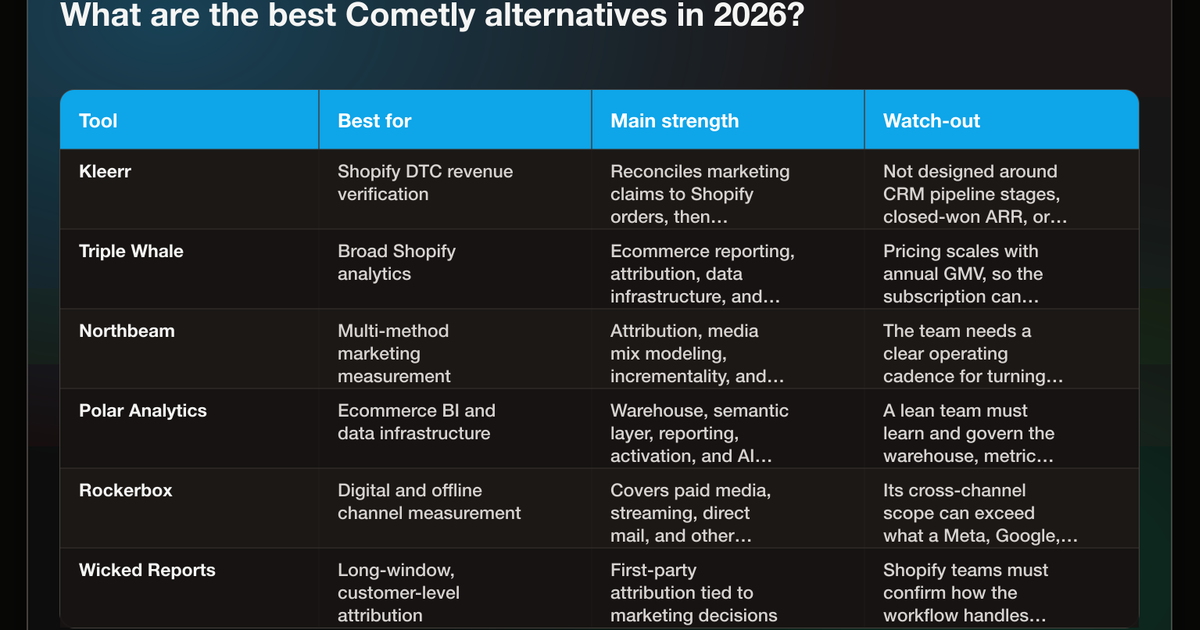
The best Cometly alternatives in 2026 cover eight distinct jobs. Kleerr focuses on Shopify verification and activation. Triple Whale and Polar Analytics offer broad ecommerce platforms. Northbeam and Rockerbox provide wider measurement depth. Wicked Reports, SegMetrics, and RedTrack support specialized customer journeys, funnels, and traffic operations.
| Tool | Best for | Main strength | Watch-out |
|---|---|---|---|
| Kleerr | Shopify DTC revenue verification | Reconciles marketing claims to Shopify orders, then supports audiences and conversion signals | Not designed around CRM pipeline stages, closed-won ARR, or general B2B attribution |
| Triple Whale | Broad Shopify analytics | Ecommerce reporting, attribution, data infrastructure, and AI tools in one platform | Pricing scales with annual GMV, so the subscription can rise with revenue even if usage stays narrow |
| Northbeam | Multi-method marketing measurement | Attribution, media mix modeling, incrementality, and ad-platform optimization | The team needs a clear operating cadence for turning several measurement methods into weekly decisions |
| Polar Analytics | Ecommerce BI and data infrastructure | Warehouse, semantic layer, reporting, activation, and AI agents | A lean team must learn and govern the warehouse, metric layer, activation tools, and agent workflows |
| Rockerbox | Digital and offline channel measurement | Covers paid media, streaming, direct mail, and other channels | Its cross-channel scope can exceed what a Meta, Google, and email-focused Shopify team needs |
| Wicked Reports | Long-window, customer-level attribution | First-party attribution tied to marketing decisions | Shopify teams must confirm how the workflow handles refunds, new versus repeat buyers, and order-level reconciliation |
| SegMetrics | Coaches, creators, and long nurture funnels | Contact-level journeys across marketing and sales tools | Its lead, course, subscription, and sales-funnel model is different from a Shopify order-led workflow |
| RedTrack | Affiliate and multi-source performance tracking | Tracking, conversion APIs, automation, and campaign management | Its affiliate, rule automation, and multi-source traffic model may add operating work for a Shopify team using Meta, Google, and email |

What does each Cometly alternative do best?
Each Cometly alternative solves a different measurement job in 2026. Kleerr centers Shopify order verification and activation. Triple Whale and Polar Analytics cover broader ecommerce operations. Northbeam and Rockerbox add measurement breadth. Wicked Reports, SegMetrics, and RedTrack fit specialized customer journeys, funnels, or traffic models.
1. Kleerr: best for verifying Shopify revenue and acting on the result
Kleerr is best for Shopify DTC teams that need to see which ad spend created new customers, which spend received credit for repeat orders, and what should change across paid audiences and conversion signals.
Kleerr captures first-party website activity and reconciles customer, order, refund, source, and click-ID data. Kleerr then separates new-customer performance from repeat-order credit and keeps exclusions, retargeting audiences, seeds, lookalikes, and server-side signals current through the Kleerr marketing measurement platform.
In one 2026 Shopify audit, GA4 had placed 40,071 sessions into “Unassigned.” After Kleerr reprocessed the journeys using available source evidence, 3,097 sessions remained unassigned. The campaigns the brand was preparing to cut included campaigns that were creating demand. This was one brand’s result, not a market benchmark, according to Kleerr’s Shopify ecommerce measurement example.
Best for: Shopify DTC teams that need order-level revenue reconciliation and activation based on current customer state.
Trade-off: Kleerr is built around ecommerce orders, refunds, customers, and marketing activation. A B2B SaaS company that measures CRM stages, subscriptions, pipeline, and closed-won ARR may fit Cometly better.
Disclosure: Kleerr makes one of the tools in this comparison.
2. Triple Whale: best for a broad Shopify analytics suite
Triple Whale is best for Shopify brands that want attribution, ecommerce reporting, data infrastructure, and AI tools inside one broad platform.
Triple Whale’s current pricing and product page lists attribution, Triple Pixel, a managed data platform, Moby AI, Sonar products, Compass measurement, dashboards, and custom business intelligence. Triple Whale also publishes pricing that changes with annual gross merchandise value.
Triple Whale’s breadth is useful when a team wants one platform for many ecommerce reporting jobs. Its GMV-based pricing also means cost can rise as the brand grows, even when the team uses only a focused part of the suite.
Best for: Shopify teams that will use a broad analytics and reporting suite.
Trade-off: Triple Whale makes the most sense when the team will use several products across its platform. A team with one narrow revenue-verification question should compare the full GMV-based cost against the specific workflows it will use.
3. Northbeam: best for combining multiple measurement methods
Northbeam is best for brands that want multi-touch attribution, media mix modeling, incrementality, and ad-platform optimization in one marketing measurement suite.
The Northbeam product site presents multi-touch attribution, media mix modeling, incrementality, product analytics, creative analytics, and Northbeam Apex for ad-platform optimization. That range suits teams that want several methods for different budget questions.
Northbeam’s measurement depth is valuable when a team has the operating process to compare MTA, MMM, incrementality, and campaign data. A lean growth team must decide who will interpret those methods, resolve conflicting answers, and turn the results into weekly budget changes.
Best for: Brands with a complex paid-media program and a need for several measurement methods.
Trade-off: Northbeam asks the buyer to operate a multi-method measurement system. A small team without a dedicated analyst may struggle to use every layer consistently enough to justify the added depth.
4. Polar Analytics: best for ecommerce BI and data ownership
Polar Analytics is best for ecommerce brands that want reporting, a managed data warehouse, a semantic layer, activation tools, incrementality testing, and AI agents in one data platform.
The Polar Analytics platform combines ecommerce business intelligence with connectors, a Snowflake data warehouse, prebuilt metrics, first-party tracking, Klaviyo audiences, advertising signals, incrementality testing, and role-specific AI agents.
Polar Analytics fits teams that want a broad data foundation, not only ad attribution. The warehouse and semantic layer give the team more control, but somebody still needs to govern metric definitions, access, reports, activation workflows, and the questions assigned to each agent.
Best for: Ecommerce teams that want analytics infrastructure and activation together.
Trade-off: Polar Analytics includes infrastructure that a lean Shopify team must learn and govern. A team seeking one verified answer about ad revenue may not need a warehouse, semantic layer, activation suite, and several AI workflows.
Check the gap before switching tools. Run a free Kleerr account audit to compare platform claims with verified Shopify revenue and keep the report.
5. Rockerbox: best for online and offline channel measurement
Rockerbox is best for brands that need to measure digital advertising alongside channels such as streaming TV, linear TV, affiliates, influencers, and direct mail.
Rockerbox describes a unified marketing data foundation with multi-touch attribution, media mix modeling, incrementality testing, and measurement across digital and offline channels on its channel measurement page.
Rockerbox’s channel coverage is useful when a customer journey crosses online and offline media. A Shopify brand running mostly Meta, Google, and email may be adopting a measurement system built for a much wider channel map than its team operates.
Best for: Brands with a meaningful mix of online and offline media.
Trade-off: Rockerbox is designed to unify many media types and measurement methods. A digital-first DTC team should confirm that offline coverage and cross-channel complexity will change enough budget decisions to justify the broader workflow.
6. Wicked Reports: best for long-window attribution and decision tracking
Wicked Reports is best for agencies and operators that want first-party attribution across longer customer journeys and a structured link between measurement, decisions, and outcomes.
The Wicked Reports platform emphasizes first-party attribution, funnel analysis, customer-level measurement, ad-platform signals, action tools, and logged marketing decisions.
Wicked Reports may fit businesses where customer value unfolds over a longer period. Shopify teams should ask for a direct demonstration of refund handling, first-time versus repeat customers, and the order-level evidence behind each channel number before choosing it for ecommerce reconciliation.
Best for: Businesses with long customer journeys and lifetime-value-focused measurement.
Trade-off: Wicked Reports leads with attribution and decision tracking across longer funnels. A Shopify operator should confirm that its ecommerce workflow answers the narrower questions of refund-aware revenue, new-customer CAC, and repeat-order credit without extra reporting work.
7. SegMetrics: best for coaches, creators, and nurture-heavy funnels
SegMetrics is best for coaches, creators, information businesses, and other teams that need to connect long nurture journeys with purchases, subscriptions, courses, and sales activity.
The SegMetrics product site focuses on coaches and creators, contact-level journey reporting, server-side tracking, marketing funnels, subscriptions, courses, and connections across marketing and sales tools.
SegMetrics’ contact-level view fits businesses where a lead may move through email, calls, content, courses, and offers before buying. That journey model is different from a Shopify DTC workflow centered on completed orders, refunds, customer status, and paid-media execution.
Best for: Long nurture funnels, coaching businesses, and digital education products.
Trade-off: SegMetrics is built around contact journeys and nurture funnels. A standard Shopify brand may spend time adapting that model to order-level questions that an ecommerce-focused platform handles directly.
8. RedTrack: best for affiliate and multi-source performance tracking
RedTrack is best for affiliate media buyers, agencies, and brands that need flexible tracking, conversion APIs, campaign automation, and management across several traffic sources.
RedTrack’s SegMetrics alternatives article and site navigation describe tracking and attribution, conversion APIs, automated rules, ad management, data access, and use cases for affiliate media buyers, ecommerce brands, and agencies.
RedTrack’s affiliate and multi-source design can support complex traffic operations. A Shopify DTC team running Meta, Google, and email should decide whether it needs ad management, automated rules, APIs, and affiliate workflows or a narrower Shopify revenue-reconciliation process.
Best for: Affiliate operations, agencies, and multi-source paid-media programs.
Trade-off: RedTrack fits teams that actively manage tracking rules and several traffic sources. That operating model can add setup and maintenance for a Shopify brand whose main question is whether paid campaigns created new customers or received credit for repeat orders.
How much do Cometly alternatives cost?
Cometly alternative pricing varies by revenue, ad spend, data volume, features, and service level. Compare each current vendor quote for the same job and usage level. Do not compare a basic attribution plan with a package that also includes data warehousing, incrementality testing, activation, AI tools, or managed services.
As of July 2026, Triple Whale publishes pricing tied to annual gross merchandise value. Other vendors may provide plans, custom quotes, or sales-led packages. Current vendor pages should always override prices shown in a comparison article.
A useful cost comparison includes:
- The base subscription
- Required add-ons
- Data or spend limits
- Number of brands or client workspaces
- Historical lookback
- Onboarding and support
- Audience and conversion-signal syncing
- Internal analyst or engineering time
A lower subscription can still cost more if the team must build data pipelines, maintain spreadsheets, or hire outside analysts. A broader suite can be the better value when the team uses most of the platform.
How should you choose between Cometly and its alternatives?
Choose between Cometly and its alternatives by naming the revenue event, budget decision, and action your team needs in 2026. Cometly fits pipeline and closed-won measurement. Shopify DTC teams may prioritize verified orders. Other businesses may need ecommerce BI, offline measurement, long-window journeys, or affiliate tracking.
Use this five-step process:
- Name the revenue event. Decide whether the source of truth is a Shopify order, Stripe payment, CRM opportunity, booked call, subscription renewal, or another completed outcome.
- Name the budget decision. Write the exact question the platform must answer, such as “Which campaign created new customers?” or “Which channel produced closed-won revenue?”
- Check the evidence. Ask whether every summary number can be traced to the customers, orders, payments, clicks, or experiments behind it.
- Check what happens next. Decide whether the team needs reporting only or also needs audiences, conversion signals, automated rules, and campaign actions.
- Price the full workflow. Include subscriptions, add-ons, setup, data work, analyst time, and ongoing maintenance.
A product demo should use the team’s real decision, not a polished sample dashboard. Ask every vendor to show how the platform handles one disputed channel number from evidence to action.
Which Cometly alternative is best for Shopify DTC brands?
Kleerr, Triple Whale, and Polar Analytics are the most direct Cometly alternatives for Shopify DTC teams in 2026, but each serves a different job. Kleerr focuses on verified revenue and action. Triple Whale offers a broad ecommerce suite. Polar Analytics combines ecommerce BI, data infrastructure, activation, and AI tools.
Kleerr is the clearest fit when the main question is whether ad-platform claims match refund-aware Shopify orders and whether paid spend created a new customer.
Triple Whale is stronger when the team wants a wide range of ecommerce dashboards and analytics products in one platform.
Polar Analytics is stronger when the team wants a broader data foundation with business intelligence, a warehouse, activation, and AI tools.
Cometly remains a better fit when the company’s central question is how ads create leads, pipeline, subscriptions, and closed-won revenue across a B2B SaaS stack.
Frequently asked questions about Cometly alternatives
Buyers comparing Cometly alternatives in 2026 usually ask whether Cometly fits ecommerce, which product is closest, whether attribution can be trusted, and how much switching will cost. The answers depend on the business model, source-of-truth revenue event, media mix, operating resources, and actions the team needs after measurement.
What is the closest alternative to Cometly?
Northbeam is a close alternative for broad marketing measurement. RedTrack is a closer option for tracking and campaign operations. Kleerr is a better comparison for Shopify revenue verification. The closest product depends on whether the business measures pipeline, ecommerce orders, affiliate conversions, or omnichannel sales.
Is Cometly good for ecommerce?
Cometly supports consumer technology and paid-ad use cases, but Cometly’s public positioning in July 2026 leads with B2B SaaS, Stripe revenue, pipeline, and closed-won ARR. A Shopify DTC team should compare Cometly against tools built around orders, refunds, new customers, repeat buyers, and ecommerce activation.
What is the best Cometly alternative for agencies?
The best agency alternative depends on the client book. Cometly fits agencies serving B2B SaaS. Triple Whale and Polar Analytics fit ecommerce reporting. Kleerr fits Shopify revenue verification and activation. Rockerbox fits omnichannel clients. RedTrack fits affiliate and multi-source media operations.
Can an attribution platform prove that advertising caused a sale?
Attribution alone cannot prove causation. Attribution assigns credit using observed touches and a selected model. A randomized holdout or another valid experiment is needed to estimate what would have happened without the advertising. Teams should keep attributed revenue and incremental revenue clearly separated.
Should a Shopify brand switch tools when platform numbers disagree?
A Shopify brand should audit the disagreement before switching tools. Different attribution windows, identity methods, and counting rules can produce different totals. The useful test is whether a platform can trace the disputed number to completed Shopify orders and show how the answer changes a budget or audience decision.
How is Kleerr different from Cometly?
Cometly focuses on connecting advertising to SaaS pipeline, subscriptions, and closed-won revenue. Kleerr focuses on Shopify DTC measurement. Kleerr reconciles marketing claims with customers, orders, refunds, and source evidence, then uses verified customer state in audiences, exclusions, lookalike seeds, and server-side signals.
How can you verify your ad numbers before switching?
Shopify DTC teams comparing Cometly alternatives should first test whether their current ad budget creates new customers or collects credit for repeat orders. A connected, refund-aware audit gives the team a decision to compare across vendors before it replaces software or changes campaign budgets.
Book a Kleerr ecommerce demo to review how that connected read would work with your existing marketing stack.
About the author
Daniel Pisterzi is the founder of Kleerr, a marketing analytics company for growing ecommerce brands. Daniel works directly on first-party measurement, Shopify revenue reconciliation, audience activation, and the systems that help DTC teams decide where the next marketing dollar should go.