Updated July 24, 2026.
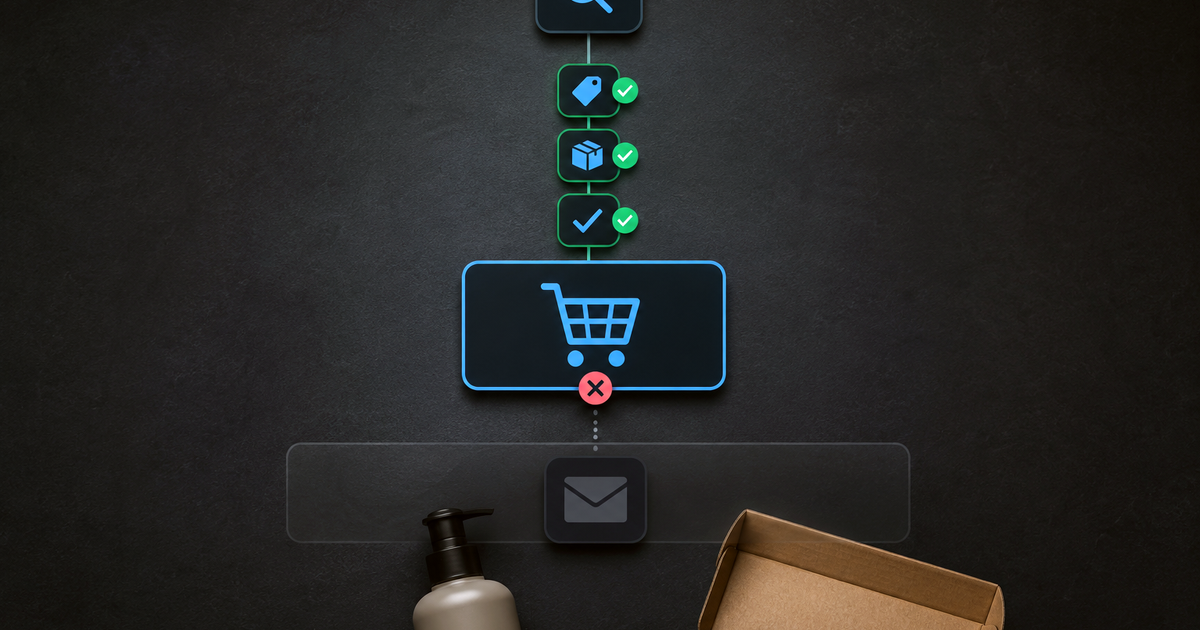
Checkout abandonment recovery helps Shopify brands turn started but unfinished checkouts into completed orders. The strongest 2026 approach fixes checkout friction first, then uses email, SMS, and paid retargeting only when the shopper can be reached and the message still makes sense. Every recovered order should tie back to Shopify.
TL;DR
>
> - Checkout abandonment happens after a shopper starts checkout but before Shopify records a completed order.
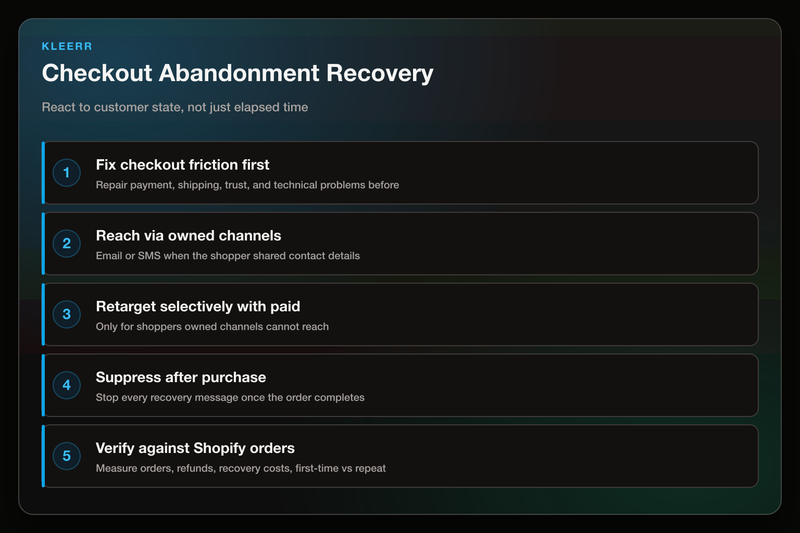
> - Fix payment, shipping, trust, and technical problems before sending more reminders.
> - Use email or SMS when the shopper has shared contact details. Use paid retargeting selectively for shoppers owned channels cannot reach.
> - Stop every recovery message after purchase.
> - Measure completed Shopify orders, refunds, recovery costs, and first-time versus repeat buyers.
What is checkout abandonment?
Checkout abandonment happens when a shopper begins the checkout process but leaves before Shopify records a completed order. For Shopify DTC brands in 2026, the key distinction is intent: a checkout abandoner moved past browsing and cart building, but payment, shipping, trust, or timing still stopped the purchase.
Checkout abandonment is narrower than cart abandonment.
| Customer action | What happened | What the store knows |
|---|---|---|
| Product viewed | The shopper showed interest | Product and session activity |
| Item added to cart | The shopper created a cart | Cart contents and value |
| Checkout started | The shopper entered checkout | Stronger purchase intent and checkout details |
| Order completed | Shopify recorded a purchase | Customer, order, payment, and revenue |
| Checkout abandoned | Checkout started, but no order followed | Intent without a completed purchase |
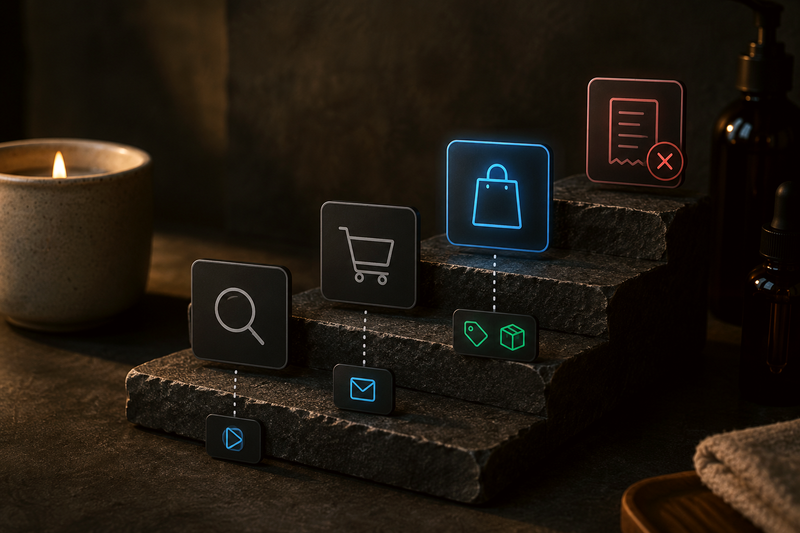
The difference matters because the response should match the customer’s stage.
A product viewer needs education. A cart abandoner needs a reminder. A checkout abandoner needs help with payment, shipping, delivery, trust, or a technical problem.
Treating all three shoppers as the same audience creates weak messages and unnecessary ad spend.

What is checkout abandonment recovery?
Checkout abandonment recovery is the set of changes and follow-up actions used to help an unfinished checkout become a completed order. For Shopify DTC teams in 2026, recovery includes fixing checkout friction, sending owned-channel reminders, using paid retargeting selectively, suppressing buyers after purchase, and measuring revenue against Shopify orders.
A complete recovery program has three parts:
- Prevent the abandonment. Remove avoidable checkout friction.
- Reach the shopper. Use email, SMS, or paid media when the shopper is eligible and identifiable.
- Verify the result. Confirm that Shopify recorded the order and stop every other recovery action.
Recovery should not mean sending more reminders to everyone.
A shopper who cannot use the preferred payment method needs a checkout fix. A shopper who got distracted needs a reminder. A shopper who already bought should leave every recovery audience immediately.
The best recovery system reacts to customer state, not just elapsed time.
Why do shoppers abandon checkout?
Shoppers abandon checkout when the cost, effort, risk, or timing of the purchase changes before payment. Across dozens of studies, the average documented cart abandonment rate sits close to 70%, and extra costs such as shipping, taxes, and fees rank as the most-cited reason shoppers leave, according to Baymard Institute research. Shopify brands should diagnose the exact stage where customers leave instead of assuming every abandoned checkout needs a discount. A recovery message cannot repair a payment error, unexpected shipping charge, broken page, or unclear delivery promise.
Common causes include:
| Possible cause | Evidence to inspect | First response |
|---|---|---|
| Unexpected shipping cost | Drop-off after shipping options appear | Make shipping costs clear earlier |
| Delivery uncertainty | Questions about arrival dates or fulfillment | Show clear delivery expectations |
| Payment failure | Payment error or repeated payment attempts | Fix the payment path and offer help |
| Missing payment option | Exit after reaching payment selection | Review the payment methods customers expect |
| Account friction | Exit near login or account creation | Reduce avoidable steps |
| Mobile usability problem | High drop-off on a device or browser | Test the checkout on real devices |
| Trust concern | Exit near payment or policy details | Make returns, support, and security information clear |
| Distraction or delay | No clear technical or pricing problem | Send a simple reminder |
| Discount hunting | Repeated visits without purchase | Review promotion rules before adding an offer |
Start with the checkout record and customer journey.
Look at the last completed step, the device, the payment state, the cart value, the shipping destination, and whether the shopper returned. Those signals help separate a broken checkout from a shopper who simply needs time.
Do not treat a discount as the default fix. A discount can recover an order while teaching customers to abandon future checkouts and wait for another offer.
How does checkout abandonment recovery email work?
Checkout abandonment recovery email sends a relevant reminder after an identified shopper starts checkout but does not complete an order. For Shopify brands in 2026, the email should restore the checkout, answer the most likely concern, and stop immediately after purchase. Email cannot recover shoppers whose usable email address was never captured.
A useful checkout abandonment recovery email should contain:
- The products left in checkout
- A clear return-to-checkout link
- Current price and availability information
- Shipping or delivery details when relevant
- A direct way to get help
- A clear sender name the shopper recognizes
The message sequence should add information instead of repeating the same reminder.
| Message role | Useful content | Avoid |
|---|---|---|
| Reminder | Checkout link and saved items | A long promotional pitch |
| Friction check | Payment, shipping, delivery, or support details | Pretending to know why the shopper left |
| Final follow-up | A clear reason to return, when justified | Automatic discounting for every shopper |
Email timing should follow the customer’s state.
If Shopify records a purchase before the email sends, cancel the email. If the customer returns and changes the checkout, use the latest information. If the checkout expires or stock changes, avoid sending a link that leads to a broken experience.
The email tool also needs enough identity to act. A shopper who enters checkout without sharing a usable email address remains outside an email flow, even when the store captured strong purchase intent.
How can SMS and ads support checkout abandonment recovery?
SMS and paid ads can extend checkout abandonment recovery when email cannot reach the shopper or fails to bring the shopper back. For Shopify DTC brands in 2026, SMS requires a usable phone relationship, while paid retargeting should focus on eligible high-intent shoppers and stop as soon as Shopify records a purchase.
Each channel has a different job:
| Channel | Best use | Main risk |
|---|---|---|
| Detailed reminder and checkout restoration | Missing email identity or inbox delay | |
| SMS | Short, timely follow-up for eligible contacts | Message cost and excessive frequency |
| Paid retargeting | Reaching eligible shoppers outside owned channels | Paying to reach someone already reachable or converted |
| On-site recovery | Fixing friction during the return visit | Showing the same message to every shopper |
Owned channels should handle eligible shoppers before paid retargeting adds more cost. Paid media should focus on shoppers who remain eligible and have not completed the order.
Every channel needs purchase suppression.
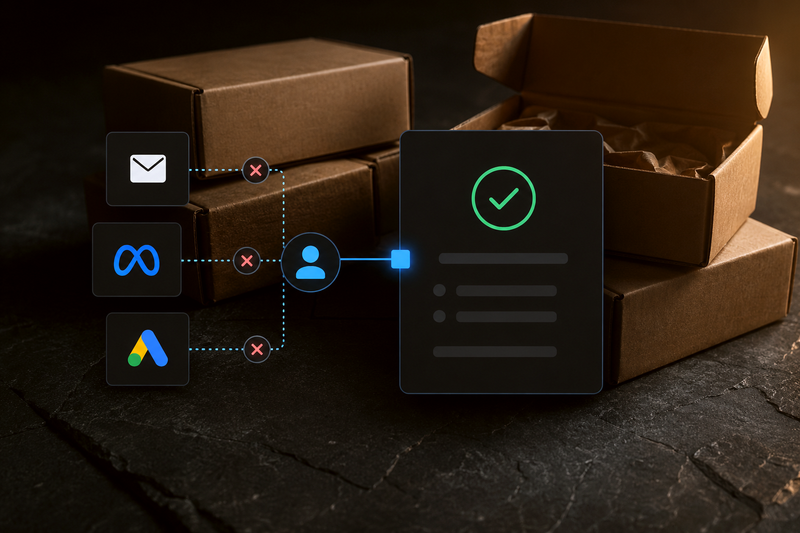
A checkout abandoner becomes a buyer the moment Shopify records the completed order. Email, SMS, and paid audiences should respond to that change quickly enough to prevent a buyer from seeing stale recovery messages.
This is where Kleerr's coordination layer fits: it runs email, SMS, and ads off one customer state, so a buyer is suppressed across every recovery and acquisition audience the moment Shopify records the order.
How to reduce checkout abandonment?
To reduce checkout abandonment, Shopify brands should remove preventable friction before adding more recovery messages. In 2026, the practical order is to inspect checkout failures, clarify total cost and delivery, test payment paths, simplify the customer experience, and then use email, SMS, or paid retargeting for shoppers who still leave.
Use this process:
- Define the checkout start. Choose the Shopify event or checkout state that marks real checkout intent.
- Confirm the completed order. Use a recorded Shopify order as the success event. Do not treat a button click or payment attempt as completed revenue.
- Segment the failure point. Separate exits before customer details, shipping, payment, and final confirmation.
- Test the checkout yourself. Test common devices, browsers, payment methods, discount codes, shipping regions, and cart sizes.
- Make the full cost clear. Show shipping, taxes, duties, subscriptions, and recurring charges before the final payment step when possible.
- Reduce avoidable work. Remove unnecessary fields, confusing account steps, and repeated data entry.
- Answer the last purchase question. Make delivery, returns, support, and payment information easy to find.
- Build channel-specific recovery. Use email for identified email contacts, SMS for eligible phone contacts, and paid retargeting for qualified shoppers who remain reachable there.
- Suppress completed buyers. Stop recovery messages and remove buyers from paid recovery audiences after Shopify records the order.
- Measure net results. Compare completed orders, refunds, discounts, message costs, and paid spend rather than counting clicks alone.
Want a clearer view of where recovery spend overlaps with existing customers? Find my wasted spend to see where email, SMS, and ads pay twice for the same Shopify customer before changing the channel mix.
How should Shopify brands measure checkout abandonment recovery?
Shopify brands should measure checkout abandonment recovery with completed, refund-aware orders rather than clicks, opens, or platform-reported conversions alone. For 2026 budget decisions, the report should separate recovered checkouts by channel, customer status, cost, discount, and order outcome so email, SMS, and paid media do not each claim the same purchase.
Start with a clear denominator.
Checkout completion rate
`completed orders ÷ started checkouts × 100`
Checkout abandonment rate
`unfinished checkouts ÷ started checkouts × 100`
Recovery rate
`completed orders after a recovery action ÷ eligible abandoned checkouts × 100`
The definition of “after a recovery action” must be explicit. A click-based rule, an attribution window, and an order-matched rule can produce different answers.
Track these measures together:
| Measure | Question answered |
|---|---|
| Started checkouts | How much checkout intent existed? |
| Completed orders | How many checkouts became Shopify orders? |
| Recovery rate | How many eligible abandoners later purchased? |
| Net recovered revenue | What remained after refunds and discounts? |
| Recovery cost | What did email, SMS, offers, and ads cost? |
| First-time versus repeat buyer | Did recovery acquire a customer or collect another order? |
| Channel overlap | Did multiple recovery channels claim the same order? |
| Suppression delay | Did messages continue after purchase? |
Platform dashboards offer a useful tradeoff. Meta, Google, email, and SMS reports are fast, familiar, and useful for managing each channel. Modeled attribution can also fill gaps where direct evidence is missing.
The limitation is perspective. Each platform measures from its own data and rules. A Shopify budget decision needs a neutral order ledger that prevents the same recovered checkout from becoming several separate wins.
In one live Shopify store audit covering 30 days, Kleerr found that 38.5% of ad-attributed new customers had bought before. That is one store, not a market benchmark. The result shows why recovery reporting should separate first-time buyers from repeat orders before paid retargeting gets acquisition credit.
Attribution still does not prove incrementality.
A recovered order does not prove that the reminder, discount, or ad caused the purchase. Only a controlled holdout can establish causal lift. Until a holdout exists, use careful language such as “ordered after the reminder” rather than “the reminder caused the order.”
What does checkout abandonment recovery Reddit advice get right?
Checkout abandonment recovery Reddit discussions help Shopify operators identify practical symptoms, such as broken checkout steps, weak email copy, aggressive discounting, or ads that continue after purchase. Reddit advice works best as a list of hypotheses. Store data, test orders, customer support records, and completed Shopify orders should decide the actual fix.
Reddit discussions are good at surfacing questions a dashboard misses:
- Does the checkout fail on a specific phone or browser?
- Does a discount code remove free shipping?
- Does the reminder reopen the correct cart?
- Are sold-out items still shown in recovery messages?
- Does the customer see an ad after buying?
- Are customers waiting for the automatic discount?
- Does the payment method work in every target region?
The weak advice starts with a tactic and skips the diagnosis.
Examples include sending more messages, adding a large discount, changing the attribution window, or launching another retargeting campaign without proving why shoppers left.
Use a simple validation process:
- Record the Reddit suggestion as a hypothesis.
- Reproduce the checkout path on the relevant device.
- Inspect the actual Shopify checkout and order states.
- Check email, SMS, and audience eligibility.
- Run a limited change.
- Compare completed orders and net revenue.
- Keep the change only if the evidence supports it.
Reddit can reveal a pattern. Shopify data should determine whether the pattern exists in your store.
What checkout abandonment recovery workflow should Shopify teams use?
A checkout abandonment recovery workflow should move from diagnosis to contact, suppression, and verification. For Shopify DTC teams in 2026, the workflow should start with a real checkout event, choose the least wasteful eligible channel, stop when Shopify records a purchase, and report one verified order rather than several channel-specific wins.
Use this operating sequence:
- Capture the checkout start. Record the products, value, customer identity available, and checkout state.
- Wait for the purchase state. Do not classify an active checkout as abandoned too early.
- Check channel eligibility. Determine whether email, SMS, or an ad platform can reach the shopper.
- Choose the first useful action. Fix a known checkout problem or send the most relevant owned-channel reminder.
- Watch for a completed order. Shopify should remain the source of the purchase state.
- Suppress the buyer. Stop email and SMS recovery, then remove the buyer from paid recovery audiences.
- Escalate carefully. Use paid retargeting only for shoppers who remain eligible and have not converted.
- Reconcile the outcome. Connect the order to the customer, recovery actions, costs, discounts, and refunds.
- Review the result by segment. Compare new buyers, repeat buyers, cart value, device, channel, and failure stage.
- Test causation separately. Use a controlled holdout before claiming a recovery action created incremental revenue.
The workflow should fail safely. If customer state is uncertain, avoid sending a stale offer or treating an unverified conversion as revenue.
FAQ: Checkout abandonment recovery
Checkout abandonment recovery combines checkout improvements, customer follow-up, purchase suppression, and order-level measurement. For Shopify brands in 2026, the main questions concern when abandonment starts, which channel should respond, whether discounts are necessary, and how to prove that one completed order was not counted by several recovery tools.
What is checkout abandonment?
Checkout abandonment occurs when a shopper starts checkout but leaves before Shopify records a completed order. Checkout abandonment is different from cart abandonment because the shopper has moved further into the purchase process.
Is checkout abandonment the same as cart abandonment?
No. Cart abandonment begins when a shopper adds an item to the cart but does not buy. Checkout abandonment begins after the shopper starts checkout. The narrower checkout group shows stronger intent and provides clearer clues about shipping, payment, delivery, or technical friction.
What should a checkout abandonment recovery email say?
A checkout abandonment recovery email should show the saved items, provide a working return-to-checkout link, answer likely purchase questions, and offer support. The email should not pretend to know why the shopper left.
Should every checkout abandonment email include a discount?
No. A discount should solve a real pricing objection or support a planned offer strategy. Automatic discounts can reduce margin and train customers to delay purchases. Test the checkout experience and message clarity before adding an incentive.
Can paid ads recover an abandoned checkout?
Paid retargeting can reach eligible checkout abandoners outside email or SMS. Paid recovery adds media cost, so Shopify brands should exclude completed buyers and avoid paying to reach customers who are already responding through owned channels.
When should checkout recovery messages stop?
Checkout recovery should stop when Shopify records the completed order, when the shopper loses channel eligibility, when the checkout is no longer valid, or when the sequence reaches its defined limit. Purchase suppression should apply across email, SMS, and paid audiences.
How do you know whether checkout abandonment recovery worked?
Match the recovery action to a completed Shopify order, then account for refunds, discounts, message costs, and paid spend. A purchase after a message shows association. A controlled holdout is required to prove that the recovery action caused incremental revenue.
What is the biggest checkout abandonment recovery mistake?
The biggest mistake is treating every abandoner as the same person with the same problem. Checkout friction, contact eligibility, customer status, purchase completion, and channel cost should determine the response.
Ready to improve checkout abandonment recovery?
Checkout abandonment recovery works best when Shopify, email, SMS, and paid audiences respond to the same customer state. That is what Kleerr coordinates: it runs owned and paid off one verified customer, sequences them so email leads and ads only fire when email fails, and suppresses everyone the moment they buy, measured by a layer with no channel of its own to sell. Find my wasted spend to see where recovery spend is paying twice on your own store.
Sources checked
- Baymard Institute, cart and checkout abandonment rate statistics and checkout usability research.
- Kleerr Shopify store audit (anonymized), case study.
About the author
Daniel Pisterzi is the founder of Kleerr, the owned and paid coordination layer for Shopify DTC brands. He works on customer identity, full-journey resolution, and running email and ads off one customer view so brands stop paying to reach people they already have or already sold.