
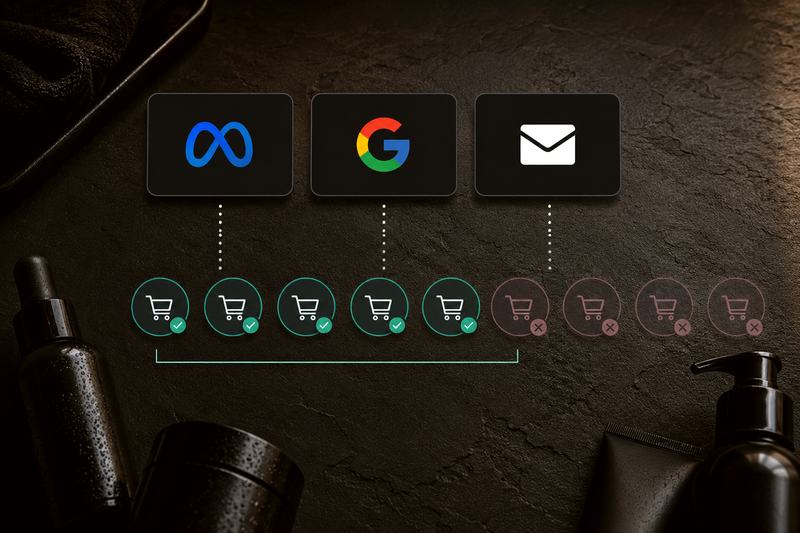
Your blended MER can look fine while one channel is buying back customers your email list already owns. What is MER marketing? MER, or marketing efficiency ratio, measures total revenue against total marketing spend. For Shopify DTC brands in 2026, MER is a fast way to see whether paid spend is efficient at the business level. MER does not show which channel deserves the next dollar.
TL;DR
> - MER means marketing efficiency ratio.
> - MER is calculated as total revenue divided by total marketing spend.
> - Shopify DTC brands use MER to judge blended marketing efficiency, not channel-level truth.
> - MER can look healthy while Meta, Google, email, or SMS are claiming the wrong orders.
> - Use MER for the board-level read. Use verified attribution to decide where budget should move.
What is MER marketing?
MER marketing is a blended efficiency metric that compares total revenue to total marketing spend. For Shopify DTC brands doing $10M to $50M in annual revenue in 2026, MER helps leaders see whether the whole marketing engine is producing enough revenue for each dollar spent, before they inspect channel details.
The formula is simple:
| Metric | Formula | Example |
|---|---|---|
| MER | Total revenue ÷ total marketing spend | $500,000 revenue ÷ $100,000 spend = 5.0 MER |
A 5.0 MER means the business generated $5 in revenue for every $1 spent on marketing.
MER is useful because MER does not depend on one ad platform's attribution model. MER uses business totals. That makes MER cleaner than looking only at Meta ROAS, Google Ads ROAS, or email-attributed revenue.
MER is also limited. MER can show that marketing efficiency is up or down, but MER cannot prove which campaign, channel, or audience caused the change.
For Shopify DTC operators under margin pressure, MER answers one question: "Is total marketing spend efficient enough?"
MER does not answer the next question: "Where should the next $10,000 go?"
How do you calculate MER in marketing?
Calculate MER by dividing total revenue by total marketing spend for the same time period. For Shopify DTC brands in 2026, use one clean reporting window, such as a week or month, and keep revenue and spend definitions consistent across every MER calculation, so trends stay comparable.
The basic formula:
```text
MER = total revenue / total marketing spend
```
Example:
| Period | Total revenue | Total marketing spend | MER |
|---|---|---|---|
| June 2026 | $600,000 | $120,000 | 5.0 |
| July 2026 | $650,000 | $150,000 | 4.33 |
In the July example, revenue increased. MER fell.
That matters because revenue growth can hide weaker efficiency. A Shopify brand can grow top-line revenue while paying too much for each order.
Use the same revenue basis each time. If your finance view uses net revenue after refunds, discounts, and cancellations, use that same basis for MER. If your reporting uses gross sales, MER will look cleaner than the cash reality.
For Shopify teams, the practical rule is simple: define revenue once, define spend once, and do not change the formula when the number gets uncomfortable.

What is a good MER for ecommerce?
A good MER for ecommerce depends on margin, repeat purchase rate, paid spend level, and growth stage. For Shopify DTC brands in 2026, MER should be judged against contribution margin and cash goals, not against a generic benchmark from another brand or a dashboard screenshot from a different category.
A beauty brand with strong repeat purchase can survive a lower first-order MER than a low-repeat apparel brand. A supplement brand with subscriptions may accept lower front-end efficiency if retention is strong. A product with thin gross margin needs a higher MER to protect cash.
Use MER with these inputs:
| Business factor | Why MER changes |
|---|---|
| Gross margin | Higher margin can support lower MER |
| Repeat purchase | Strong retention can support higher acquisition spend |
| Discounting | Heavy discounting can make revenue look better than profit |
| Refund rate | Refunds can make gross MER misleading |
| New versus repeat mix | Repeat buyers can inflate MER while acquisition gets worse |
MER becomes useful when MER connects to your operating model.
For a Shopify DTC brand, the question is not "What MER is good?" The better question is "What MER keeps contribution profit healthy while the brand acquires enough new customers?"
Is MER the same as ROAS?
MER is not the same as ROAS. MER compares total revenue to total marketing spend across the business. ROAS compares attributed revenue to ad spend inside a channel, campaign, or platform. Shopify DTC brands should use MER for blended efficiency and ROAS for channel-level diagnosis before moving budget.
The difference:
| Metric | What the metric measures | Best use |
|---|---|---|
| MER | Total revenue ÷ total marketing spend | Business-level marketing efficiency |
| ROAS | Attributed revenue ÷ ad spend | Channel, campaign, or platform performance |
| CAC | Customer acquisition cost | Cost to acquire a new customer |
| Contribution profit | Revenue after variable costs | Cash-quality growth |
MER is harder for one platform to distort because MER uses total revenue and total spend.
ROAS is more granular, but ROAS depends on attribution rules. Meta can claim revenue from one view. Google Ads can claim revenue from another view. Email and SMS can also take credit for orders that paid ads influenced.
That does not make ROAS useless. ROAS is useful when ROAS is checked against real orders and clean customer status.
Kleerr helps Shopify teams compare platform-reported ROAS against verified ecommerce revenue through verified attribution, so MER and channel ROAS can support the same budget decision instead of fighting each other.
Why does MER matter for Shopify DTC brands?
MER matters because Shopify DTC teams often feel the pain before dashboards explain the cause. In 2026, Meta, Google, email, SMS, and Shopify can all show different versions of performance while cash, margin, and inventory tell a simpler story about whether growth is healthy.
MER gives founders and growth leads a fast pressure gauge.
If MER falls while revenue rises, the brand may be overpaying for orders. Paid spend might be scaling into weaker audiences. Discounts might be pulling forward demand. Retargeting might be chasing buyers who would have bought through email.
MER is not the full answer. MER is the warning light.
For Shopify brands doing $10M to $50M in annual revenue, MER is most useful when paired with:
| Question | Metric to check |
|---|---|
| Is marketing efficient overall? | MER |
| Are new customers getting more expensive? | New-customer CAC |
| Which channel deserves more budget? | Verified ROAS |
| Are repeat buyers hiding acquisition weakness? | New versus repeat split |
| Are refunds or discounts masking weak spend? | Net revenue and contribution profit |
MER tells the team whether the engine is efficient. Verified attribution tells the team where to adjust the engine.
What does MER hide?
MER hides channel mix, customer type, incrementality, refunds, discounts, and attribution conflict. For Shopify DTC brands in 2026, MER can look stable while the brand spends too much on retargeting, underfunds paid search, or mixes repeat buyers into acquisition results.
MER is a blended metric. Blended metrics smooth out the details.
Blended metrics are useful for a quick read. Blended metrics are dangerous for budget allocation.
MER can hide these problems:
| Hidden issue | Why MER misses the problem |
|---|---|
| Retargeting tax | Total revenue can rise while paid retargeting chases existing buyers |
| Repeat-buyer mix | Repeat orders can make acquisition look healthier than acquisition is |
| Channel over-credit | Multiple platforms can claim the same order |
| Channel under-credit | A platform can influence orders that another channel closes |
| Refunds and discounts | Gross revenue can overstate cash-quality performance |
| Delayed conversion | A campaign can assist orders after the platform window closes |
In one Shopify audit, Kleerr found a $60,027 swing across two major ad channels after platform-reported performance was reconciled against verified Shopify revenue. That audit is one client across one defined period, not a market benchmark, but the case shows why MER needs a channel-level check before budget moves. See the Shopify marketing data audit.
MER is the map from altitude. Budget decisions need the street view.
How should Shopify teams use MER with attribution?
Shopify teams should use MER as the top-level efficiency read and attribution as the channel-level explanation. In 2026, a healthy workflow starts with MER, checks new-customer CAC, reconciles platform claims against verified orders, then moves budget based on verified revenue instead of self-reported channel credit.
Use this order:
- Check MER. Confirm whether total marketing spend is getting more or less efficient.
- Check new-customer CAC. Separate acquisition from repeat purchase behavior.
- Check platform claims. Compare Meta, Google, email, and SMS against Shopify orders.
- Check customer type. Split new buyers, repeat buyers, high-LTV buyers, and refund-heavy buyers.
- Move budget. Shift spend toward the channel with verified economics, not the channel with the loudest dashboard.
The honest tradeoff: platform attribution is faster and cheaper to read. Meta and Google Ads can show campaign-level reporting without a separate audit layer. Platform attribution speed is useful for daily optimization.
The problem is that platform attribution is not neutral. Each platform sees the journey from that platform's view.
Verified revenue is slower than a native ad dashboard, but verified revenue is better for a budget decision because verified revenue starts from completed orders. For Shopify teams, the budget question is not "Which platform reported the best ROAS?" The budget question is "Which spend would the business miss if the spend stopped?"
If MER shows pressure and platform ROAS disagrees, run a free marketing data audit before cutting or scaling the wrong channel.
How can MER guide budget decisions?
MER can guide budget decisions by showing whether total spend is creating enough revenue, then forcing deeper checks when efficiency changes. For Shopify DTC brands in 2026, MER should trigger budget questions, not replace channel-level proof, especially when spend rises across multiple channels.
Use MER as a decision trigger:
| MER movement | What to ask next | Possible action |
|---|---|---|
| MER rising | Is growth still strong enough? | Test more acquisition spend |
| MER falling | Which channel got less efficient? | Audit platform claims |
| MER flat while spend rises | Are paid dollars reaching weaker buyers? | Check new-customer CAC |
| MER strong while cash is weak | Are refunds or discounts masking profit? | Check net revenue and margin |
| MER strong while acquisition slows | Are repeat buyers carrying revenue? | Split new and repeat customers |
MER is strongest when MER creates a clear next step.
If MER falls, do not cut the highest-spend channel by default. The highest-spend channel may be the channel creating demand. The better move is to compare self-reported performance against verified orders, then shift budget toward the channel with the cleaner cost per order.
Kleerr can also help teams build custom audience segments from real behavior such as orders, sessions, and ad clicks, so the verified read can turn into suppression, seeding, and retargeting decisions. For example, a team can separate new buyers from repeat buyers before scaling prospecting, then suppress verified repeat buyers from paid acquisition audiences.
What MER mistakes should ecommerce teams avoid?
Ecommerce teams should avoid treating MER as a complete attribution system. In 2026, MER is useful for Shopify DTC leaders because MER is simple, but MER becomes risky when teams use one blended number to judge channels, campaigns, creative, or customer quality without verified order checks.
Avoid these mistakes:
| Mistake | Why the mistake hurts |
|---|---|
| Using MER as channel proof | MER cannot show which channel created the order |
| Comparing brands by MER alone | Margin, retention, and discounting change the answer |
| Ignoring new versus repeat mix | Repeat buyers can hide rising acquisition costs |
| Using gross revenue only | Refunds and discounts can make spend look healthier |
| Cutting spend from a blended view | The channel that looks expensive may be creating demand |
| Trusting platform ROAS without order checks | Platform views can disagree with Shopify revenue |
The better workflow is simple.
Use MER to spot pressure. Use verified revenue to find the source. Use audience and budget actions to reduce wasted spend.
For Shopify DTC brands, MER is the dashboard number that starts the conversation. MER should not be the number that ends the conversation.
FAQ: what is MER marketing?
MER marketing is a blended efficiency view that helps Shopify DTC teams judge total marketing spend against total revenue. MER is useful for founders, growth leads, and ecommerce leaders, but MER needs verified attribution, new-customer CAC, and customer-level checks before major budget changes.
What does MER stand for in marketing?
MER stands for marketing efficiency ratio. MER compares total revenue with total marketing spend for the same period.
What is the MER formula?
The MER formula is total revenue divided by total marketing spend. A Shopify brand with $500,000 in revenue and $100,000 in marketing spend has a 5.0 MER.
Is MER better than ROAS?
MER is better than ROAS for a blended business read. ROAS is better than MER for campaign-level diagnosis when ROAS is reconciled against verified orders.
Can MER be too high?
MER can be too high if the brand is underinvesting in growth. A very high MER may mean the Shopify brand is protecting short-term efficiency while missing profitable acquisition volume.
Why did MER drop when revenue grew?
MER drops when marketing spend rises faster than revenue. A Shopify brand can grow revenue and still become less efficient if the next layer of spend reaches weaker buyers or less profitable orders.
Should MER include agency fees?
MER should include any cost the leadership team treats as marketing spend. The important rule is consistency. Use the same spend definition every period.
Does MER show incrementality?
MER does not show incrementality. MER shows blended efficiency. Incrementality requires a separate method to estimate what revenue would have disappeared without the spend.
How often should Shopify teams check MER?
Shopify teams should check MER weekly for trend changes and monthly for operating decisions. Daily MER can be noisy because purchase timing, promotions, and attribution windows shift revenue across days.
Ready to check what your MER is hiding?
MER shows whether marketing spend is efficient, but MER does not show which channel deserves the next dollar. If platform ROAS and Shopify revenue tell different stories, the next step is a verified read against real orders before the team cuts, scales, or reallocates budget.
For Shopify DTC teams, Kleerr helps compare self-reported platform performance with verified ecommerce revenue, then turns the gap into clearer budget and audience decisions. Book a demo for ecommerce teams.
Sources checked
- Shopify Help Center, Measuring marketing performance, checked July 9, 2026.
- Shopify Help Center, Analytics discrepancies, checked July 9, 2026.
- Meta Business Help Center, About attribution models and attribution settings, checked July 9, 2026.
- Google Ads Help, Data discrepancies: factors and troubleshooting, checked July 9, 2026.
About the author
Daniel Pisterzi owns the Kleerr content brief and leads Kleerr's marketing analytics positioning. Daniel writes from Kleerr's work auditing Shopify ad data, comparing platform-reported performance to verified revenue, and turning those gaps into clearer decisions for ecommerce operators.