Updated July 10, 2026.
> TL;DR
> - View through attribution gives an ad credit when someone sees it, does not click, and buys later within the attribution window.
> - It can help measure awareness and retargeting influence, but it can also make paid media look stronger than it is.
> - The risk is not that view through attribution is always wrong. The risk is using it as if it proves the ad caused the order.
> - Shopify brands should compare view-through revenue against verified orders, click data, new-customer CAC, and channel overlap before moving budget.
View through attribution is one reason your ad platforms can claim more revenue than your store actually shows. It counts some orders after an ad view, even when the shopper never clicked. That can be useful for context, but dangerous for budget decisions if you treat it like proof.
The core question is simple: would that order have happened if the shopper had not seen the ad?
View through attribution cannot answer that on its own.

What is view through attribution?
View through attribution gives a marketing channel credit when a person sees an ad and converts later, without clicking the ad.
The logic is easy to understand. A shopper sees a Meta ad on Monday, searches the brand on Wednesday, and buys on Thursday. If the order falls inside the platform's view-through window, the platform may count that ad view as part of the conversion path.
That can be fair in some cases.
It can also over-credit ads that were only near the order, not responsible for it.
Simple example:
| Step | What happened | How view through attribution may read it |
|---|---|---|
| 1 | A returning customer sees a retargeting ad | The ad receives view-through eligibility |
| 2 | The customer ignores the ad | No click happens |
| 3 | The customer opens an email and buys | The ad platform may still claim credit |
| 4 | Shopify records one real order | Multiple tools may claim influence |
The order is real. The question is who deserves credit.
How does view through attribution work?
View through attribution uses ad impression data, conversion timing, and attribution windows to decide whether an ad view should get credit.
A platform starts with an impression. It then checks whether the same user, device, account, or modeled identity converted within a set window. If yes, the platform can report a view-through conversion.
The key word is can.
A view is not a click. It is a weaker signal.
A click shows the shopper took action. A view only shows the ad appeared in front of someone, or was eligible to appear, depending on the platform and placement.

Is view through attribution accurate?
View through attribution can be directionally useful, but it is not a clean measure of cause.
It answers, "Did someone see an ad before buying?" It does not answer, "Did the ad make them buy?"
That gap matters for DTC brands under margin pressure.
If view-through conversions are mixed into ROAS without enough scrutiny, paid retargeting can claim orders that email, SMS, brand search, or natural demand may have won anyway.
That leads to the real problem: you overpay for orders you might already own.
Why do ad platforms use view through attribution?
Ad platforms use view through attribution because many ads influence buyers without getting clicked.
That is true. Not every ad impact creates a click. A shopper may see an ad, remember the product, and buy later through another path.
The issue is incentives.
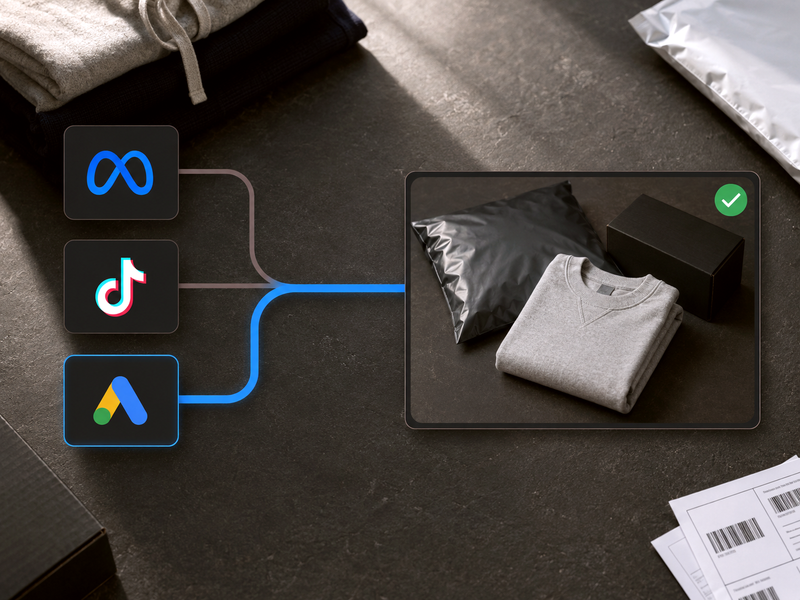
A channel-native platform sees the world through its own data. It has a reason to show the value of impressions, clicks, and conversions inside its system. That does not make the number useless. It means the number needs an audit layer, one that reconciles platform claims against verified attribution data, before it drives budget.
Use view through attribution as a signal.
Do not use it as the only source of truth.

What is the difference between view through and click through attribution?
Click through attribution gives credit after someone clicks an ad. View through attribution gives credit after someone sees an ad but does not click.
Click-through credit is usually stronger because the shopper took a clear action. View-through credit is weaker because the ad exposure may be passive, duplicated, or close to a purchase that was already likely.
| Attribution type | Trigger | Strength of signal | Main risk |
|---|---|---|---|
| Click through attribution | Shopper clicks an ad before buying | Stronger | Still may over-credit if other channels helped |
| View through attribution | Shopper sees an ad before buying | Weaker | Can claim orders the ad did not cause |
| Last-click attribution | Final tracked click before purchase | Simple and easy to read | Ignores earlier influence |
| Deterministic verification | Matches ad clicks to verified ecommerce orders | More defensible for audit work | Does not prove every non-click influence |
The best setup does not pick one number and worship it.
It compares signals. Then it asks what budget decision changes.
When is view through attribution useful?
View through attribution is useful when you need context on ad exposure, especially for awareness, video, and retargeting.
It can help answer questions like:
- Are people seeing ads before they buy through another channel?
- Do top-of-funnel campaigns show assisted demand?
- Does retargeting reach buyers who were already close to purchase?
- Are high-impression campaigns creating enough downstream activity to justify more testing?
Those are useful questions.
But they are not the same as, "Should we scale this campaign?"
For that, you need a stronger read.
When does view through attribution inflate ROAS?
View through attribution can inflate ROAS when ads receive credit for orders that would have happened without paid media.
This shows up most often in retargeting, branded demand, repeat buyers, high-intent shoppers, and owned-channel overlap.
Common inflation patterns:
| Pattern | What happens | Why it matters |
|---|---|---|
| Retargeting overlap | Paid ads reach people already on the email or SMS list | You may pay to reach buyers you can contact for less |
| Repeat-buyer overlap | Existing customers see ads before buying again | Prospecting CAC can look cleaner than it is |
| Brand-search overlap | A shopper sees an ad, then searches the brand | Paid social may claim influence on demand brand search captured |
| Discount overlap | A shopper gets a paid ad and a promo before buying | Revenue may rise while margin falls |
| Short purchase cycle | The shopper was already close to buying | The ad may be nearby, not causal |
This is why a high view-through ROAS should start a question, not end the debate.
How should Shopify brands audit view through attribution?
Shopify brands should audit view through attribution by comparing platform-reported revenue against verified orders, click data, customer type, and channel overlap.
The goal is not to prove every view-through conversion wrong. The goal is to find the budget moves that survive a stricter read.
A practical audit:
- Separate view-through from click-through conversions. Do not blend them into one ROAS number without looking at the mix.
- Compare platform-reported revenue to Shopify orders. Shopify is the order record. Use it as the anchor.
- Split new vs. returning customers. A returning buyer is not the same as a new customer.
- Check paid vs. owned overlap. Email and SMS may be doing more work than the ad platform shows.
- Look at CAC, not only ROAS. A channel can report strong ROAS while bringing in expensive new customers.
- Decide what changes. The audit should end with a budget, audience, or suppression move.
A dashboard is not enough if it stops at reporting.
The useful output is a decision.
Want to see the gap on your own account? Run a [free account audit](https://kleerr.com/audit) that compares platform-claimed revenue against your verified Shopify orders.
What should you do when view through revenue looks too high?
When view through revenue looks too high, reduce the credit you give it in budget decisions and test whether spend can move without hurting real orders.
Start with the places most likely to contain waste.
Budget and audience moves to test:
| If you see this | Test this |
|---|---|
| Retargeting claims many view-through orders | Suppress reachable email and SMS contacts from paid retargeting |
| Prospecting includes many existing buyers | Split new-customer and returning-customer audiences |
| One platform claims the win but Shopify does not support it | Compare self-reported vs. verified revenue before scaling |
| Discounts overlap with paid ads | Hold back discounts for high-intent shoppers and measure the effect |
| SMS, email, and paid all claim the same order | Sequence owned channels first, then use paid for non-responders |
Most of these moves start by isolating the right people, which is where a custom audience segment built from real orders and behavior does the work.
The point is not to cut paid media blindly.
The point is to stop paying full price for demand you could capture more cheaply.
Which attribution tool fits which job?
The best attribution tool depends on the decision you need to make.
Do not start with the longest feature list. Start with the budget question.
| Job you need done | What to look for | Main trade-off |
|---|---|---|
| Audit platform ROAS | A self-reported vs. verified revenue comparison | A strict audit may give less credit to view-through conversions |
| Reduce wasted retargeting | Audience suppression and channel-overlap analysis | You need clean customer and owned-channel data |
| Improve new-customer CAC | New vs. returning customer splits | Blended ROAS can hide the real acquisition cost |
| Measure broad media influence | Support for upper-funnel and non-click signals | Impression credit can be useful, but it is weaker than click and order data |
| Centralize reporting | Clean dashboards and source consolidation | Centralizing data does not always prove what budget should move |
| Support analyst-led measurement | Flexible data access and modeling depth | The setup may need more time and interpretation |
Every platform grades its own homework to some degree. That does not make platform data useless. It means your budget process needs a check against real orders and customer economics.
How does Kleerr treat view through attribution?
Kleerr is built for the audit question: which platform-claimed revenue matched real Shopify orders?
Kleerr uses deterministic click-to-order matching against verified Shopify orders. That creates a clearer split between self-reported platform performance and verified ecommerce revenue.
Full disclosure: we make Kleerr.
In one anonymized Shopify audit, Platform 1 claimed 5.4x ROAS and verified at 1.2x against Shopify orders. Platform 2 claimed 6.10x and verified at 8.83x. The swing across the two channels was $60,027 in one week. That is one brand over one period, not a market benchmark, according to the public Shopify marketing data audit.
The reason Kleerr belongs in this conversation is not because view-through attribution is useless. It is because view-through attribution needs a neutral check before it drives spend.
For a Shopify DTC team, the stronger workflow is:
- Start with platform-reported performance.
- Reconcile it against verified orders.
- Find the over-credit and under-credit gaps.
- Turn the read into budget and audience actions.
Those actions can include moving budget, suppressing reachable buyers from paid retargeting, separating new and returning customers, and sequencing owned channels before paid follow-up. Kleerr bundles the verified read and these actions into its plans, with no separately priced add-ons to unlock them.
That is the difference between another report and a decision.
What view through attribution metrics should you track?
Track view-through conversions, click-through conversions, verified orders, new-customer CAC, returning-customer mix, and owned-channel overlap.
Do not track view-through ROAS alone.
Useful metric set:
| Metric | What it tells you |
|---|---|
| View-through conversions | How often ads appear before orders |
| Click-through conversions | How often shoppers act on the ad |
| Verified orders | What actually happened in the store |
| New-customer CAC | What it costs to acquire a new buyer |
| Returning-customer share | Whether paid media is claiming existing demand |
| Email and SMS overlap | Whether owned channels could have captured the order |
| Refund or margin view | Whether revenue quality supports scaling |
ROAS is only useful when the revenue behind it is trustworthy.
What is a safer way to use view through attribution?
Use view through attribution as a supporting signal, not the final answer.
A safer rule is:
- Trust verified orders as the revenue anchor.
- Treat clicks as stronger evidence than views.
- Use view-through data to spot influence and overlap.
- Test budget changes before assuming causation.
- Suppress audiences where paid media is reaching people you already own.
This keeps view-through attribution in the room.
It does not let it run the budget meeting alone.
FAQ
What is view through attribution in marketing?
View through attribution gives an ad credit when someone sees it and later converts without clicking. It is often used to measure ad influence, especially for display, video, paid social, and retargeting.
Is view through attribution the same as view through conversion?
They are closely related. A view-through conversion is the conversion event counted after an ad view. View through attribution is the method that assigns credit for that conversion.
Is view through attribution bad?
No. View through attribution is not bad by itself. The risk is treating an ad view as proof that the ad caused the order.
Why does view through attribution make ROAS look higher?
It can count orders from people who saw an ad but may have bought anyway. This can make paid media look stronger, especially when retargeting, email, SMS, and brand search overlap.
Should Shopify brands use view through attribution?
Yes, but with guardrails. Shopify brands should compare view-through claims against verified orders, click-through data, customer type, and owned-channel overlap before changing budget.
What attribution window should I use for view through attribution?
Use a window that matches your buying cycle, then test sensitivity. A shorter window is stricter. A longer window gives more credit to impressions, but it can also raise the risk of over-crediting ads.
What is better, view through or click through attribution?
Click through attribution is usually a stronger signal because the shopper clicked. View through attribution can still be useful, but it should carry less weight in budget decisions.
How do I audit view through attribution?
Separate view-through and click-through conversions, compare platform claims to Shopify orders, split new vs. returning customers, check owned-channel overlap, and turn the result into a budget or audience decision.
See where your view-through revenue is real
If your ad platforms are claiming more revenue than Shopify shows, start by measuring the gap. Book a demo to see how verified orders reshape your budget decisions.
Sources checked
- Meta Business Help Center, About attribution models and attribution settings, checked July 9, 2026.
- Meta Business Help Center, About Facebook's attribution system, checked July 9, 2026.
- Google Ads Help, Data discrepancies: factors and troubleshooting, checked July 9, 2026.
- Shopify Help Center, Analytics discrepancies, checked July 9, 2026.
About the author
Daniel Pisterzi is the founder of Kleerr. He works on attribution, signal recovery, and verified budget allocation for Shopify DTC teams.